
Young Krapp, perhaps.
Krapp’s Last Tape is a play that deals in serious material. Krapp, the only character on stage, gets lost in memories of a woman he loved, and the death of his mother. But Samuel Beckett was careful to build in comedy.
Years ago I watched Harold Pinter play Krapp at the Royal Court. It was in the small upstairs theatre, there were very few performances. I’d interviewed him for the Financial Times’s Lunch with the FT slot not long before – we’d met at a restaurant he’d chosen because it stood directly across the road from the Royal Marsden, where he’d had cancer treatment. “I was alive, instead of being dead,” he told me, “if you see what I mean.” So getting a ticket felt like a real privilege.
And there were no bananas.
Beckett’s text specifically mentions bananas. Pinter cut them. He was recovering from serious medical treatment, and the physical business was clearly impossible, so I understood why. But without bananas the play was only dark. There was no light, no comedy, and I thought it was less good for that reason.
I’m hesitant even to write this down. Who am I to second-guess a Nobel laureate performing another Nobel laureate? Well, I’m a writer, and that was my honest reaction. (You can judge for yourself because Pinter’s performance was filmed, and it’s on BBC iPlayer right now.) I’m bringing it up because it reinforced something I had only half-concluded: comedy is not decoration in serious work. It’s structural.
So I was delighted to read a review of the new Krapp at the Royal Court, this time with Gary Oldman. Before getting into the serious stuff, the FT reviewer said this:
Actually, first there’s the business of the bananas. Although Oldman curtails the slapstick of slipping on a skin, which Beckett specifies in the text, the drawn-out act of eating two bananas remains a wonderfully daft opening to a play. The enormity of expressions that pass across his pinprick eyes is remarkable. You can see him visibly drift between being present and getting lost in his memories as he chomps.
Krapp’s Last Tape lives or dies on details like these.
This is partly why I tried to put funny bits into A Speccy Man Has a Breakdown. Not laugh-out-loud comedy – that would be wrong for the material – but moments that aim to be funny. If a reader has laughed at something early on, they’re more available to what comes later. They’ve agreed to be in the room with you.
In fact a version of this very thought sits inside the book:
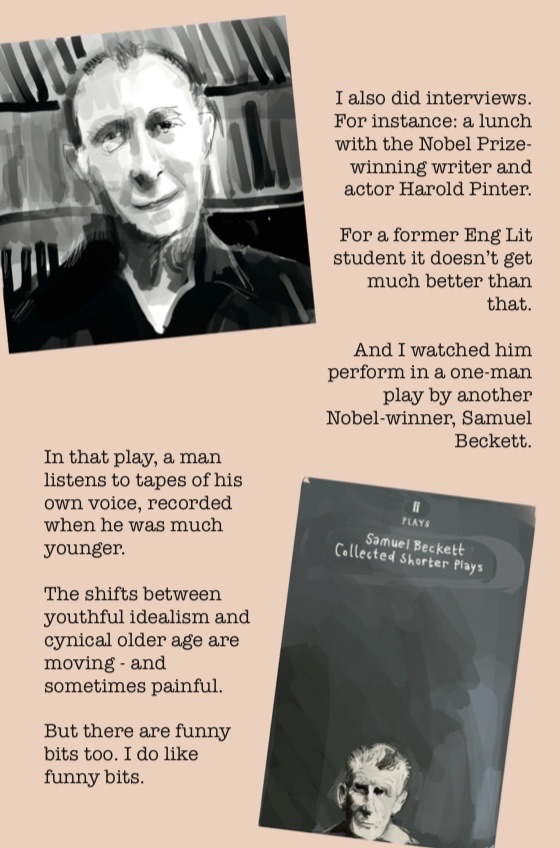
From A Speccy Man Has a Breakdown. Note FT pink background.
The clearest example I know of comedy doing serious work is Shakespeare’s Falstaff. By the time Hal rejects him – “I know thee not, old man” – we’ve spent two plays laughing with him. The tavern scenes, the lies about Gad’s Hill, the catechism on honour. The rejection works because of all that laughter. If Falstaff had only been pathetic, Hal turning away would be a footnote. Because he’s been funny, it’s a wound.
As for bananas – well they’re just quite funny. Even (or especially) when you don’t try to make them funny.