14 November 2026
Hello
In this issue: what the Speccy Man did next; your number right now (out of ten); a word about ISBNs and love letters; writing code with a fountain pen; and a man who went grocery shopping with a bow and arrow.
-
What the Speccy Man did next
Last week I promised to tell you about the next Speccy Man adventure. Here goes.
For a few years now, on and off, I’ve been drawing myself into famous works of art. Started with one. Then rather a lot. I’ve been sorting through them, putting my drawings in the order the artists were born, from a painted Egyptian mural of about 1250 BC to a Basquiat of 1982. Underneath each one there’s a label of the dry museum kind: “After so-and-so, oil on canvas, such-and-such a year.”
Sometimes the speccy man (me) takes the title role. Sometimes I take a woman’s place: I’ve been Venus, in shorts, and Whistler’s mother. Sometimes I’m a minor part, the ploughman who doesn’t notice Icarus falling. Sometimes I’m an extra who was never there at all, a third cherub, a second skater waving behind the Skating Minister. Once I’m the sculpture.
Here’s the newest one, which nobody has seen yet but you. It’s after Berthe Morisot’s Reading, of 1873: her sister Edma on the grass with a book, and me asleep beside her, head on her dress, while she carries on reading.

And here’s one from the other end of the process, already out in the world. It’s after Sickert’s Ennui, which hangs at Tate Britain. I posted it a fortnight ago, with a few lines about what the Speccy Man found himself doing in it.

It’s becoming a book, A Speccy Man’s History Of Art, a companion to the breakdown one and a good deal more cheerful. A test copy is on its way from the printer. I’ll show you when it arrives.
What’s your number?
Ben Akers is a filmmaker, and one of the founders of Talk Club, where men meet and begin by giving a number out of ten for how they’re doing. I was a guest on their podcast the other week. Afterwards I asked Ben, by voice note, for his number out of ten. He answered from a street in Bristol, and then told me how we first met: a shoot in a London park, a freelance film, a sewing book, and later a documentary about men’s mental health called Steve, for which he interviewed me and then, rightly, left me out.
What’s your number?, and How we first met, five minutes of audio. I drew Ben in August, with his nine-year-old self.
Micro-Memoir, week two
A fortnight ago a new group started a thirty-day course with me, each of them making a small illustrated book about one part of their life. It’s called Micro-Memoir, and I’ve been running it this week from wherever I happen to be: a field with the dog, a rainy window with the sea behind it, a Zoom call from a borrowed room.
Two questions came up. Does a book need an ISBN? And can you put photographs of living people in it?
On the first: no. An ISBN is plumbing for the book trade, and if your book isn’t going through the book trade, the plumbing has nothing to plumb. My own last book has no ISBN, on purpose. Putting one on it would have been like putting a barcode on a love letter. Longer answer here.
On the second: in principle, yes, much as you need no permission to put their photo in your family album. What matters is how far it travels. And the people in the pictures usually turn out to have stories you need.
Every day I’ve sent the group a short voice note, with a transcript. There are nine so far, and they’re all on the site, if you’d like to listen in.
There’ll be another group, and this page has a waiting list for it.
Markdown by hand
A fortnight ago I wrote a page of notes in a notebook, with a fountain pen, in Markdown: the plain-text way of marking up a web page that most newsletter tools now use. Then I photographed it and asked Claude to turn it into a file. It read my handwriting, worked out what I’d crossed out, and even inserted the https:// I’d left off a link. The page, and what came out.
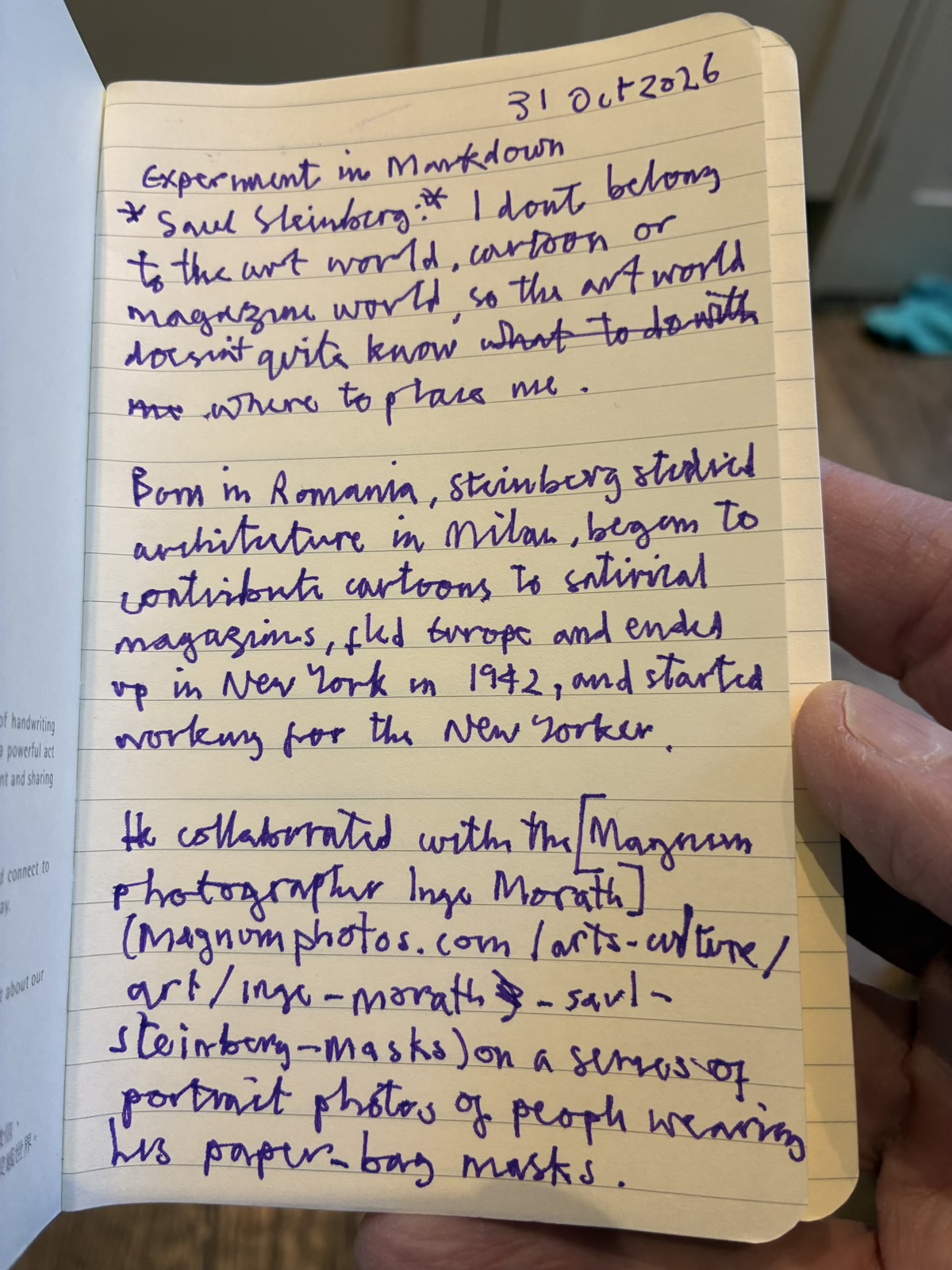
I sent it to John Gruber, who invented Markdown, thinking it might amuse him. It did. He also pointed out that Markdown isn’t so far from penmanship anyway, and offered one rule for anyone doing it with a pen: treat underlining as emphasis. Noted, for next time.
Other World News In Brief
Grocery shopping with a bow and arrow. In 1992 the artist Christian Jankowski lived for a week on what he could shoot, with a bow, in his local supermarket. The cashier scanned the arrows along with the shopping. He still had to pay.
Benchmarking. James Bridle asked several AIs to design a chair from scrap wood, built each one, and sat in them. One came out “designed by someone who has read a lot about chairs but never actually sat in one”. A long essay, worth it.
My Day In Small Drawings, now in Chinese. Matilda Tristram’s book about keeping a diary in comics has a new edition, in a new language. If you’ve ever meant to draw your day and not known where to start, you may prefer it in English.
Housekeeping
New on the site: a voice note booth. If you’d rather talk than type, press record and it comes to me.
Unoffice Hours: half an hour on a video call, Tuesday lunchtimes UK, free, no agenda, open to absolutely anybody. Book a slot:
Unoffice Hours
Free drop-in video call. One-to-one, Tuesdays.

JPF