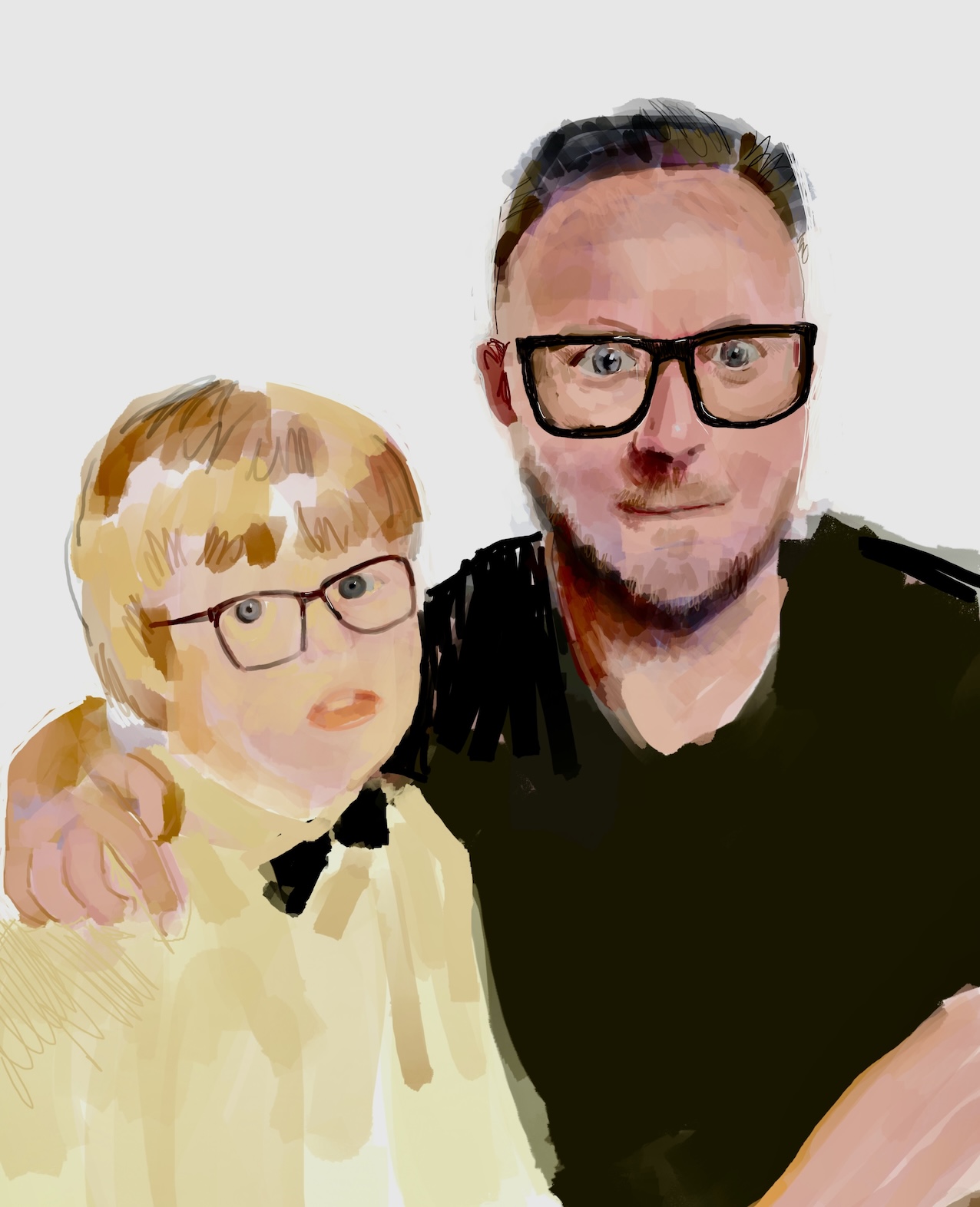
This is Ben, on the right. And on the left, aged nine or ten, is Ben. Adult Ben’s arm reaches around little Ben’s shoulder.
Ben Akers is one of the handful of people who phoned me when I was in psychiatric hospital. He did not know I was there. But when I told him, standing in a queue at the pharmacy, he understood immediately.
I had first met Ben some years before, through work. He is a film-maker. I had presented a few short scenes in a series he was making.
For this drawing, Ben sent me a photograph of himself as a small boy. The hand you can see on the child’s shoulder in the drawing is based on Ben’s father’s hand, in the original photograph. I copied it carefully.
So what you’re seeing, if you want to see it that way, is Ben giving his younger self the touch his father once gave him.
When I sent Ben the drawing, he sent me back a voice message, saying it had brought up a lot of lovely and sad feelings all at the same time:
That photograph was taken when I was about nine or ten, the same age as my son now. And it was one of the last memories I’ve got of my dad. My dad was schizophrenic. Soon after that he was committed to an institution, and sort of left us, really. I saw him fleetingly, maybe five or six times.
I saw him a bit when I was twelve or thirteen and started getting into football. For me, Saturdays meant football, and football felt more important than seeing my dad. And then, to be honest, my dad sort of said, “OK, if you want to, play football.” I hadn’t seen him after that. I got messages from him when I was about eighteen. And I haven’t seen him since. I’m about to be fifty. So, forty-nine.
That was quite an interesting period for me, looking at that, going – I knew something wasn’t right when I was nine or ten. So what would I say to my nine-year-old me? It’s going to be OK. It’s all going to be OK. This will shape you, but it won’t define you. It will make you a stronger person. You will make everything OK. Your mum – my mum! – will make everything OK. And hopefully you will become the father that you wanted and needed.
I’m a father of three. Two girls and a boy. My boy’s the middle one. I talk to him a lot about my feelings. I talk to him a lot about what’s going on. I talk to him about his feelings. We talk a lot about feelings. I think it’s really important for men to talk about feelings, so we don’t break. Because if we break, then things happen. Then mental ill health takes over.
So that is what I would say to my younger self. It’s going to be OK, because you will make it OK.
A little later, Ben messaged again:
I always worried if I was enough. That’s why I said “it’s going to be OK.”
Unconditional love is an interesting area. This painting of my dad and me is fascinating – because my son is the same age, and I am trying to give him a positive, stable, loving male role model.
Ben has built much of his working life around this. In 2014 he lost a childhood friend called Steve to suicide, and afterwards he made a documentary about male mental health – the film too is called Steve. He took it round the UK for forty-nine screenings before the pandemic.
Out of the same instinct he co-founded Talk Club – small groups of men who meet to ask each other, out of ten, how they are today. It began with eight friends at the back of the Bristol Beer Factory and now runs to more than thirty groups in several countries.
You will make everything OK.
That is the whole thing.
This is one of the portraits in Contain Multitudes, my show at Burgh House, Hampstead, 18-23 August 2026.