This morning I tried an experiment. I wrote a few lines about Saul Steinberg in my notebook, with a fountain pen, in Markdown.
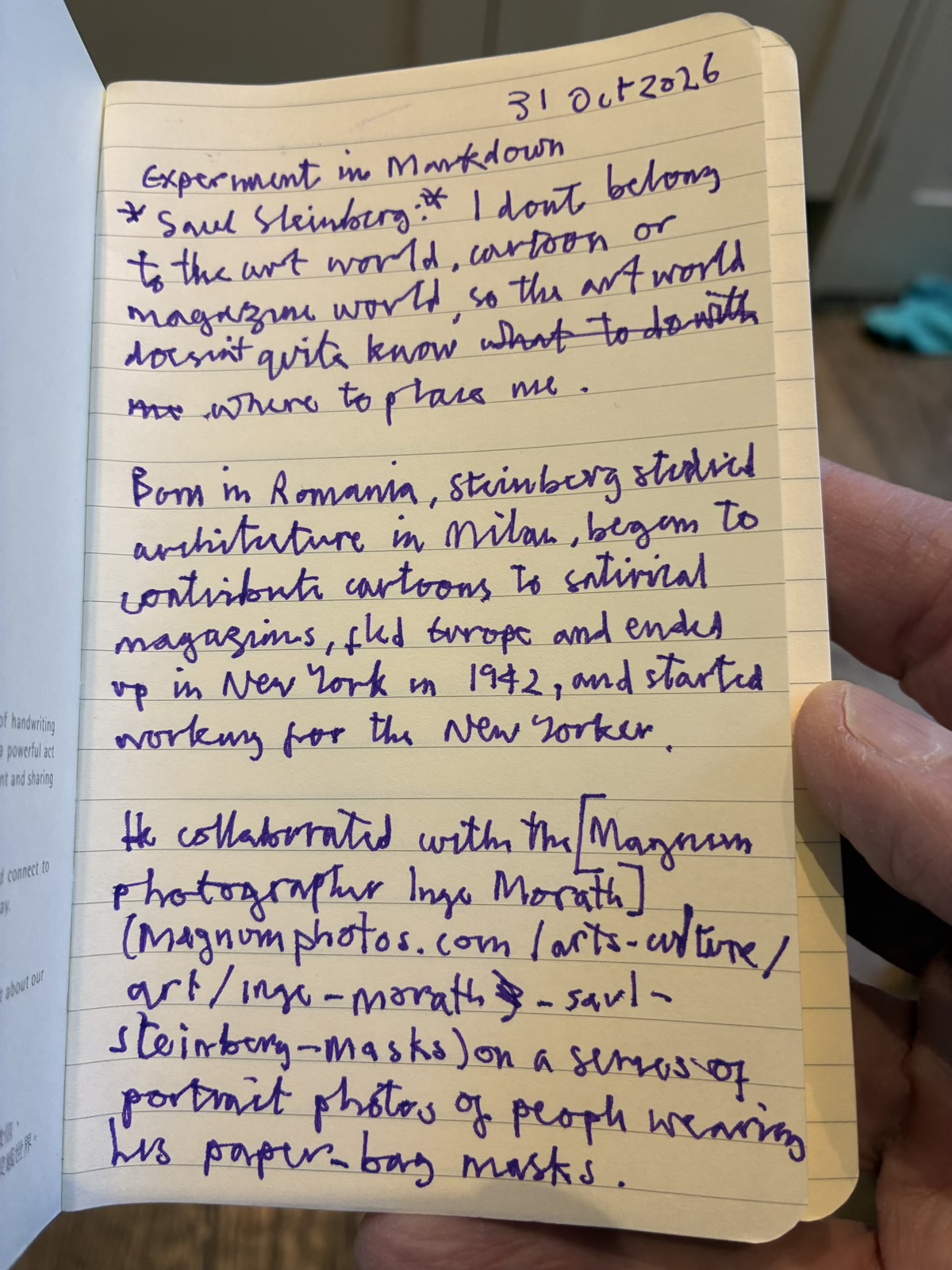
Asterisks round his name for italics. Square brackets round the link text, round brackets round the URL. The lot, by hand.
Then I photographed the page, gave it to Claude, and asked whether it could read my handwriting well enough to make a Markdown file. It could. It spotted where I’d crossed out “what to do with me” and written “where to place me”, and went with my second thought. It added the https:// I’d left off the link. Here’s what came back:
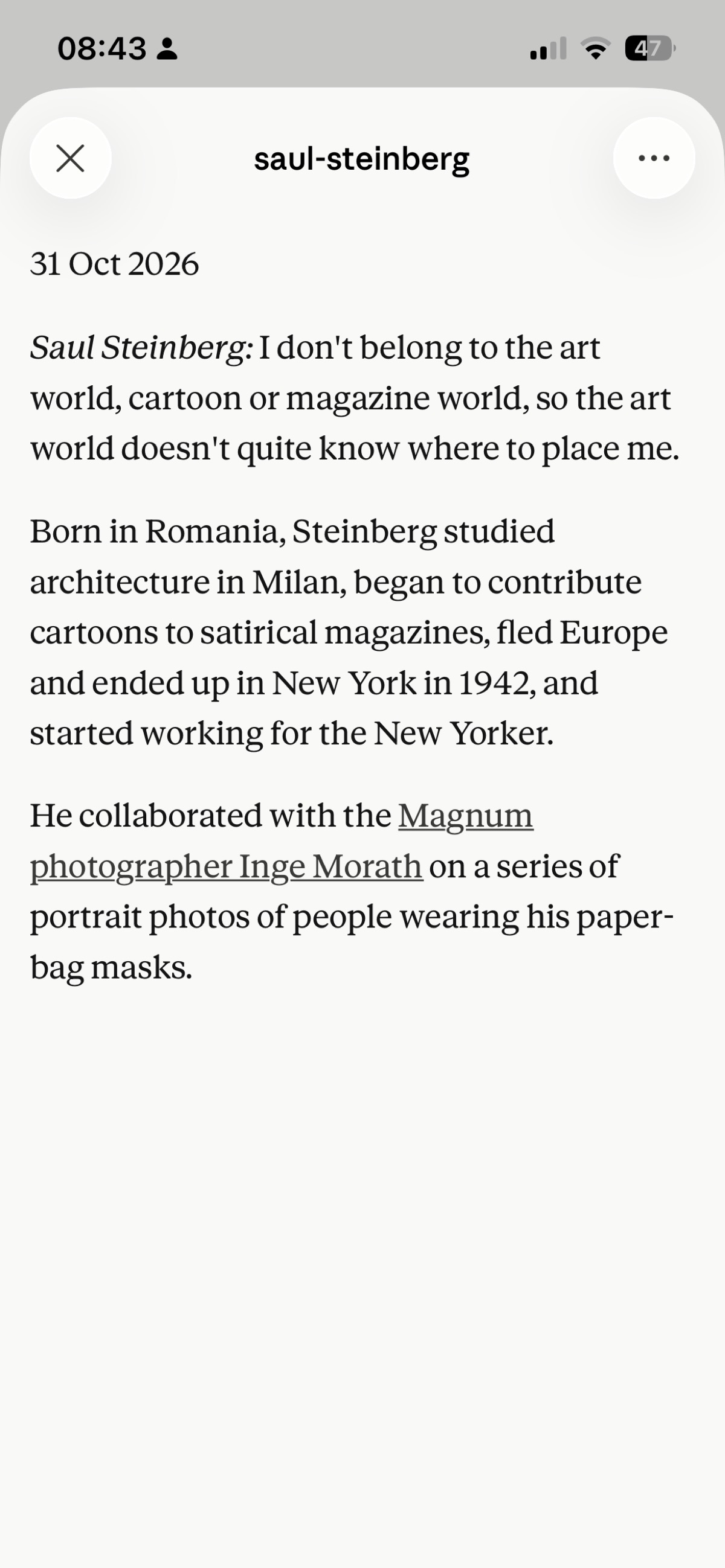
Not bad.
I should confess I don’t use Markdown. This site runs on Textpattern, which uses Textile – Markdown’s older cousin. So this was a bit like writing a postcard in someone else’s language. Steinberg would have understood. He didn’t quite belong anywhere either.
But it made me see something. Markdown was designed so that the source would read naturally as plain text, before anything turned it into a web page. It turns out that also makes it something you can write with a pen. The notebook page isn’t a draft of the file. It is the file.
One correction, for the record. Steinberg’s first drawing in the New Yorker appeared in 1941, before he’d reached New York. My notebook got the order slightly wrong. The machine read my handwriting perfectly, and copied my mistake faithfully.
If you write in Markdown, try it. Pen, paper, asterisks. Then tell me what happened.