17 October 2026
Hello
In this issue: what people actually make on my memoir course, and why a small piece of a life is worth doing; what happened after I chopped up a fat book; and some news from the Guardian.
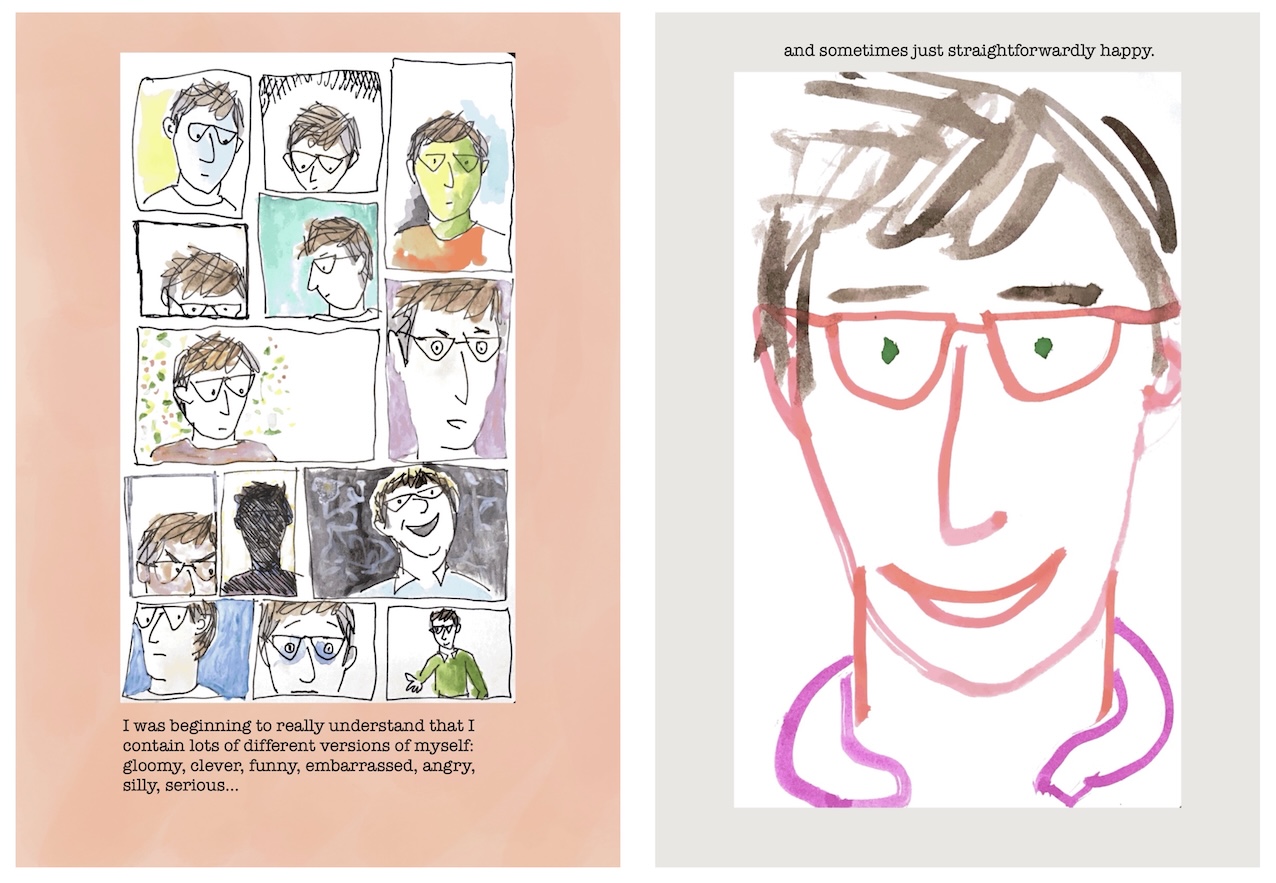
Two pages from A Speccy Man Has A Breakdown. News about that further down.
-
A life story, just not the whole life
That’s how I describe Micro-Memoir, my thirty-day course. People quite reasonably ask what it means. Which part of a life? And why would anybody want only a part?
The quickest answer is to tell you what people have made. I won’t name anyone, but I can tell you what they chose.
One wrote and illustrated the story of a relationship that began when she found a message in a bottle, washed up on a beach. Her boyfriend at the time told her not to touch it: it was just garbage. She spent the price of a stamp and wrote back anyway, and kept in touch with the person who sent it for several decades.
Another is making a book for Christmas, out of the creative work of a relative.
Another has put together the life story of her sister.
Another gave an account of what it was like to be in a band in the 1980s, which turned out to be about something else as well: a low-level dread of nuclear weapons. One of his pictures shows the band flying across the English countryside astride a missile.
And another looked back at her career so far.
None of them is a whole life. Each one takes a single thread – a relationship, a person, somebody’s work, a few years in a band, a career up to now – and follows it.
For some years I wrote obituaries for The Times, the Guardian and The Daily Telegraph. Incredible people, sensational lives, two thousand words each – and that’s only for the really big ones. Many would get just 800 words. It was impossible not to feel they’d been short-changed – but the alternative was no obituary at all. What I took from those years is the thing the course is built around: a fragment, done well, is better than a whole life left unwritten.
And a fragment gets finished. A whole memoir is the kind of project people carry around for years without starting, rather like the fat books I fear I won’t finish, and so don’t start (more on those below). Forty-eight pages is a book you can actually make. It stands complete. It might one day grow into something longer, or it might not, if that isn’t what you want from it.
The other thing about these books is that they’re illustrated. Photographs, drawings, and in the band book, pictures he wrangled from AI. Some of the books I use as case studies contain fewer words, in total, than a single long magazine feature. The pictures do half the storytelling, sometimes more.
How it works: an email arrives every morning for thirty days, with one task in it, designed to take about fifteen minutes. At the end, a real book arrives from the printer, A5, full colour, about 48 pages, with your name on it. A few weeks earlier it didn’t exist.
The part that seems to worry people is the printing. This week I recorded a short voice note asking the people already booked what exactly worries them about it, so I can deal with it before we start.
Much of what’s in the course can be found elsewhere – by asking an AI, for instance. What makes the difference is that I’m in the background for thirty days, answering questions and being supportive. I ask people to reply, especially in the first week, and I read every reply.
As it happens, this week Ryan Turpin’s first book, Wild Enough, arrived in the post, with a thank-you to me in the back. I had nothing to do with what’s in it – I didn’t even know about it. But he wrote:
Writing a book has the potential to be quite a lonely project, and a first book especially can be a real exercise in confidence-building. For those reasons, our correspondence, your newsletters, the writer’s group meetings I attended, and your unoffice hours all had an out-sized positive influence on my motivation to finish the job.
The next Micro-Memoir starts on Monday 2 November, and finishes in time to get your book printed for Christmas. Here’s what’s involved.
If you’d rather try something first, there’s a free three-day email course, fifteen minutes a day: finding the story in a photograph.
If you have a fragment of your own that has been waiting, write and tell me about it.
Chopping up books, again
Last week I told you how I chopped a fat book, Jonathan Strange & Mr Norrell, into slim volumes, and gave each one a wraparound paper cover with French flaps. Here’s where it’s got to: three sections so far, out of what I think will be six.
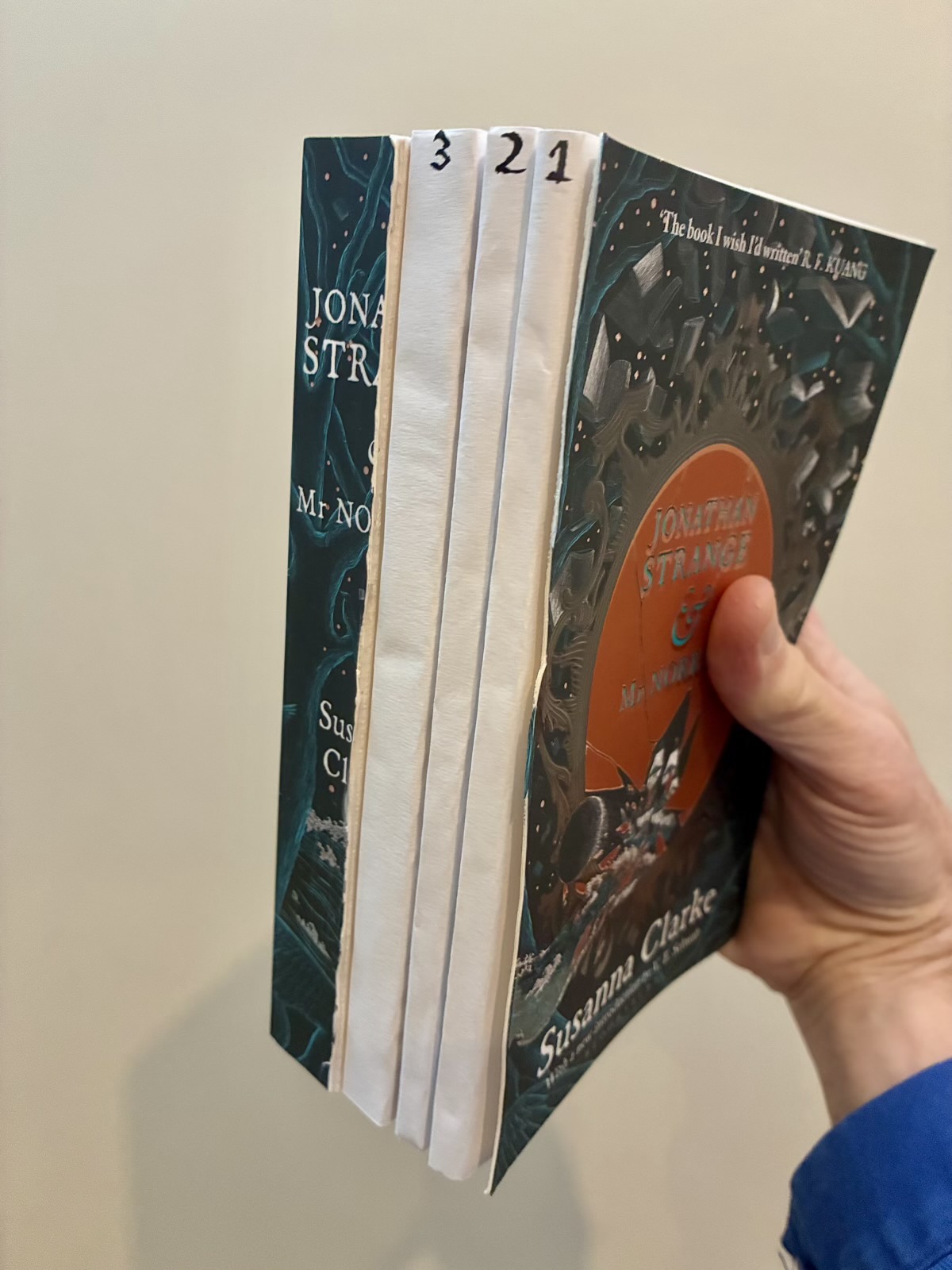
I heard from Quite A Lot Of People about it – obviously struck a nerve.
Allison told me she had very happily chopped up The Luminaries, another fat one:
It was really a testament to the novel’s worth: it was so damn good, I didn’t ever want to be without it, but too big to lug around. Simple maths, really. Many were horrified, but I’m guessing Eleanor Catton would have been thrilled to know it was bought and read.
Then a message came from someone who was an editorial assistant at Bloomsbury when Jonathan Strange & Mr Norrell was being prepared for publication. One of Mary’s jobs was photocopying batches of the manuscript to send to people around the company. She thought my doing it with French flaps was “very chic”.
Mary is now artistic director at Arvon, where I teach memoir. So when she says chic I stand a little taller.
You might notice a pattern here. I took a big book and turned it into small parts I could actually get through. It seems to be a bit of an interest of mine, doing things in small pieces. It’s the idea behind micro-memoir, obviously. And it’s not far from my habit of sharing work in progress, to accumulate something bigger.
If you’d like a short series of emails showing how to chop up a book, step by step, with pictures, reply and say CHOP. If enough people do, I’ll make one.
Talking it in, writing it out
Sharing work in progress is how I made my own micro-memoir, A Speccy Man Has A Breakdown. I’d been telling people on my course that they could make a short book in thirty days, and in March I set out to prove it to myself. I sent a short email (almost) every day to a small group of people who specifically asked for it, describing what I was doing. Mine ran to 124 pages, because once I started I couldn’t stop.
It’s a good way to get work done, I find: just share the work in progress.
In the same spirit, this week I recorded myself talking about how I have now rewritten a piece for the Guardian Magazine about the book. I’d answered the editor’s questions by talking out loud, which took it from 2,600 words to 5,900 – way too long. So I went back to typing, cut whole stories, hunted down my spoken tics (very, really, just), and finished with a red pen, on paper, over lunch. Voice to generate, the page to judge. Two different jobs.
What I haven’t told anyone yet: on Thursday Ruth, at the Guardian, said she is very happy with it. It’s due to go in the magazine on Saturday 2 January, apparently.
Other World News In Brief
They tell people on writing courses to “show, don’t tell”. Sometimes telling is better: “Reader, I married him.” Neal Stephenson has what he considers a particularly bold example, from Jane Austen. The reader can imagine
Jas Knight, an artist on the Met’s copyist programme in New York, says you haven’t begun to see a painting until you’ve copied it. Day two of my free photo course asks you to do the same with a photograph, however scrappily.
At Unoffice Hours this week I talked to someone who works in what used to be a shop. It got me thinking about the empty shops near me – there are about four in the next few blocks – and whether creative people should go onto the high street. The empty shop on the corner
Matt Webb, who gave me the idea for Unoffice Hours, has made a weather app that tells you how today compares with yesterday – because you can remember what you wore yesterday.
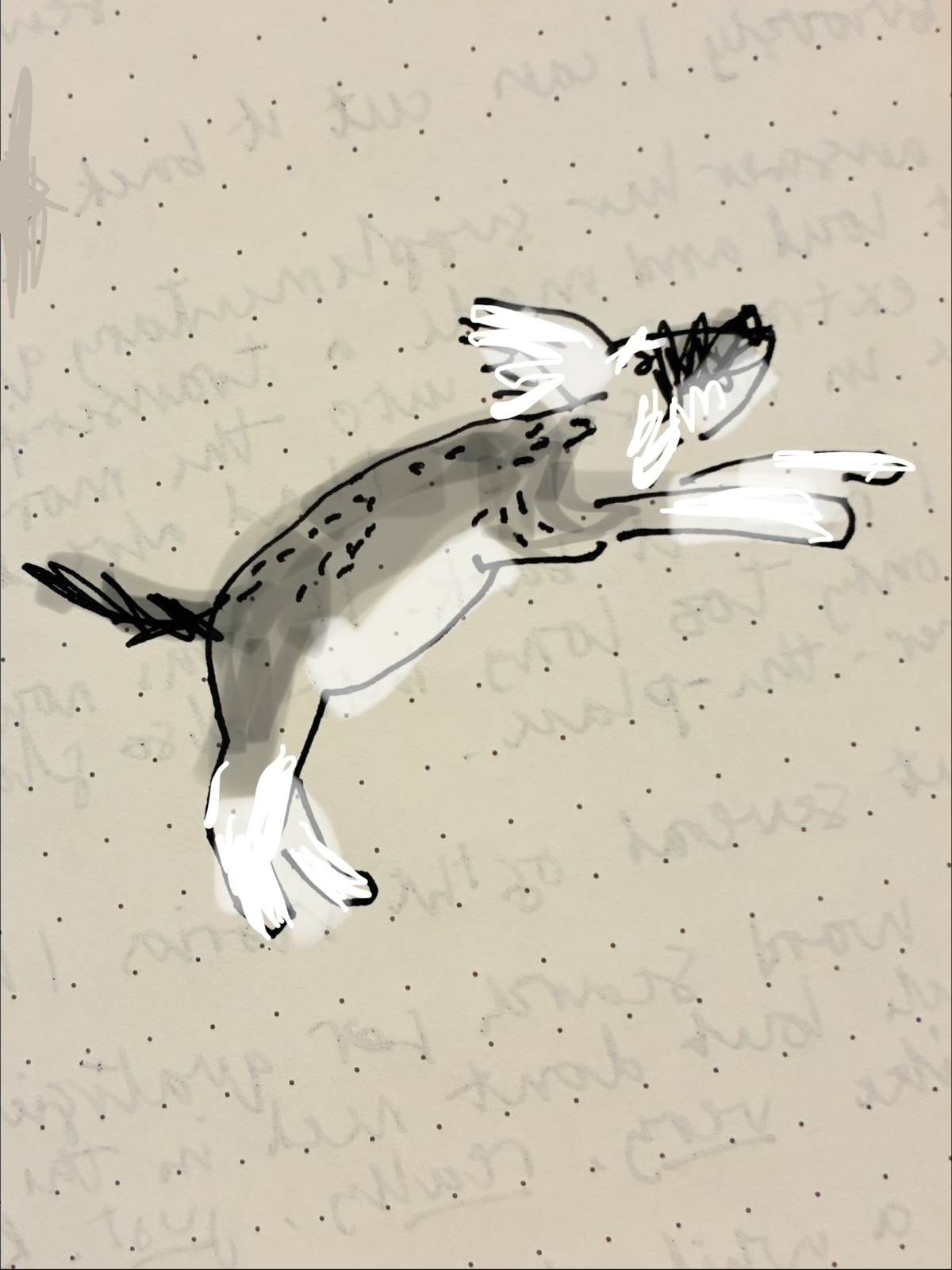
Peanut the dog sometimes lies still like a silver bullet, waiting to have her teeth brushed. Sometimes she dashes upstairs to hide in her bed. Night off
Housekeeping
Unoffice Hours: half an hour on Zoom, Tuesday lunchtimes UK, free, no agenda, open to absolutely anybody. Book a slot:
Unoffice Hours
Free drop-in Zoom. One-to-one, Tuesdays.
This arrives weekly. If that’s too often, reply and say MONTHLY and I’ll send you a monthly round-up instead.

JPF