Pacing yourself
A pep talk for writers
This is something I sent to participants halfway through my Micro-Memoir course1. I’m sharing it here because the idea behind it matters beyond the course itself.
This is a short message, to set out what’s possible, and how much can be achieved even if you think you’re falling behind.
As I tell people on the course, this is all about getting something printed instead of nothing. I like to keep in mind the idea that in 100 years time someone, somewhere, might stumble on this physical artefact you are making.
They may find it a little baffling, and have lots of questions. But they’ll treasure it.
They can’t treasure something that remains forever only in your head.
***
It’s great to dream big, but I want to set out very clearly how valuable even something wonky and incomplete can be. I’ve shown you already the booklet I put together for Charmian, containing some family photos and lots of blank pages.
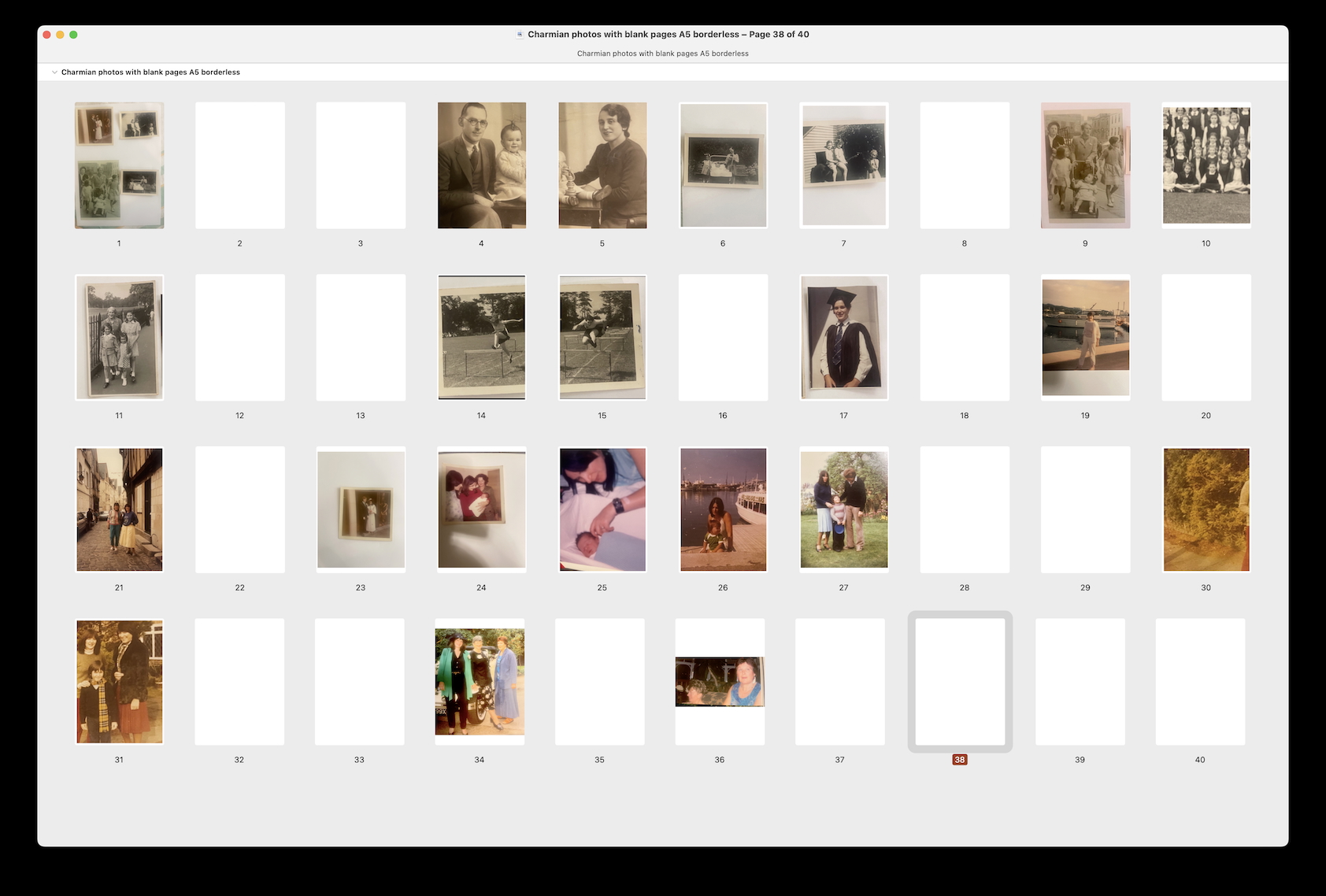
That booklet is valuable just as it is, because it exists instead of not.
It might be even better if Charmian sat down to months of research and wrote it up in the most exquisite prose.
Or somewhere in between: if she just scribbled a few captions on the blank pages, by hand.
The point I’m making is that you will have achieved something terrific if you only put together a booklet of photos, carefully sequenced over 44 pages.
***
Of course, some people doing this course may not be particularly interested in using photos. You might want to make a micro-memoir that is entirely written, no pictures at all.
Great! Each to their own. In that case, even scribbling a few notes across all those pages could do the job for your book, as a first iteration.
It might be even better if you write it with beautiful calligraphy, or typeset it like a genius.
Or somewhere in between.
***
As long as you create something, you can’t go wrong.
Of course you will look at it when it’s finished and wonder if you could have made it better by doing such-and-such.
But that could be said for any creative work, forever.
***
You might still be trying to work out the “right” length for your writing.
Well, it can vary enormously, which gives you plenty of slack. Maira Kalman’s memoir about her mother contains approximately 3,000 words over 128 pages. And I used that as a rough guide for my own latest book.
But you could write much more, in a book with less than half that many pages.
Quick reasoning: an A5 page at 12pt with 1.2 spacing and normal margins fits around 250 – 280 words per page. Across 44 pages that’s about 11,000 – 12,000 – but you’ll lose pages to a title page, blank verso, section breaks, and any illustrations, so a realistic target for body text lands closer to 9,000 – 10,000.
There’s more to say, another time, about how you can tweak your writing to make it more compelling to readers, and about laying out your pages and getting them in the right sequence to upload to a printer.
For now, the message is simple: pace yourself, and make something.

JPF
1 Micro-Memoir course. More details in the shop.