Two small books, and what I mean by micro-memoir
Two small books, and what I mean by micro-memoir
Two great specimens of what I’ve been calling a micro-memoir. That’s my term, not the publisher’s – but they’re the clearest examples I know of the form, and help explain why almost anyone could make one.
They show that a micro-memoir can be a “proper” book, from a proper publisher, with excellent reviews – if that’s what you want.
***

Two books: Farthings, by CB Editions, and beneath it Days and Nights in W12 by Jack Robinson – a pseudonym for Charles Boyle, who is also the publisher at CB editions.
Notice how thin they are, and how much white space there is inside. A micro-memoir needn’t be tons and tons of words. Nobody’s asking you to fill every page.
Short can be great! Geoff Dyer described Days and Nights in W12 as being “like the best moments from a novel minus the padding”.

The book is structured as an alphabet – with at least one entry for every letter, A to Z. Pictures paired with text.
Just 110 pages, plus index, but it gives you an amazing sense of place, and of the person who wrote it.
Nick Lezard, in the Guardian, wrote that this book isn’t just about W12 – it’s about every urban space, including the one in your head. Another well-known critic, John Self, praised it too.

The other book, from the same author / publisher is even smaller – 40 pages about being a publisher. The structure of Farthings is even looser: just 113 numbered entries, with no obvious sequence, and yet works perfectly.
If you want more structure, you could build your memoir around the shape of a year, or a room, journey, job, set of tools…
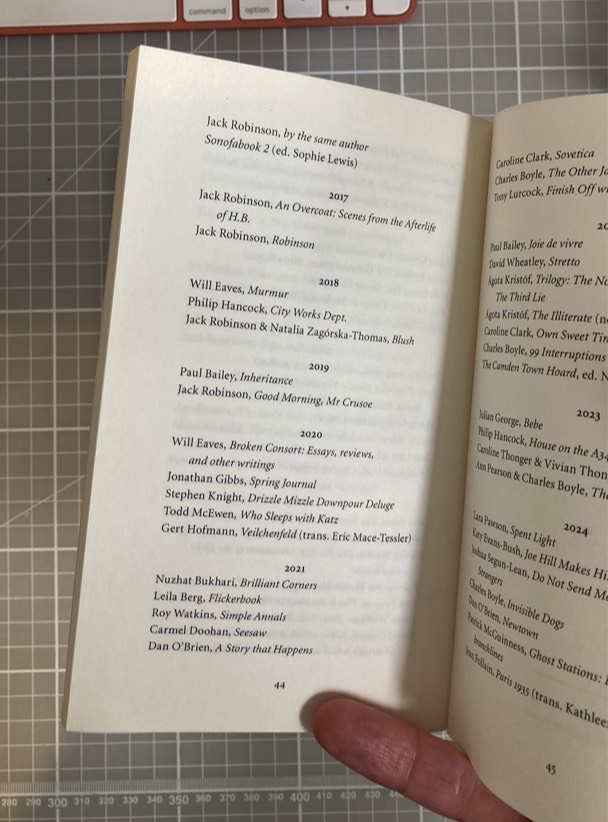
Both these books from CB Editions have lists at the back, including (in this picture) a list of all the books that company has published.
(I’m happy to note that CB’s lists include my friend Elise Valmorbida, who I’ve taught with at Arvon several times, and Will Eaves, who worked alongside me in my first-ever journalism job.)
What list might you write at the back of your own small book? An index? A dedication? A record of the people who talked you into finishing it?
***
One thing I love about both these books is the way they elevate the humdrum, the everyday.
One entry in Farthings is a photograph of the post office where every book ordered from the CB editions website – a number now in the thousands – has been taken by Charles for weighing and posting. It’s a lovely piece because it’s so specific: the counter, the weighing, the number.
Thanks to Charles, I spotted something similar of my own: three photos of the Evri machine at my local Parcelshop, where every copy of my own micro-memoir, A Speccy Man Has A Breakdown, has gone through the same little routine.
Everyone has an equivalent – the small repeated everyday centre of what you do, that perhaps you’ve stopped noticing. What’s yours?
***
A micro-memoir contains a fragment of a life, or a slice of one, in physical form. It’s something almost anyone literate can put together in a fairly short time – and once it’s a book, it lasts.
The alternative is either never to write something down at all, or write it into some digital place that may or may not still be there in even a few years. A physical book, however slight, may be found by someone years from now.
Of course not everyone wants to write a 300-page memoir, but almost everyone has one thing to tell – a place, a job, a year, a room – that would make a lovely small book.
One of my course participants, Charmian, wanted to make a book about her sister but was daunted by the thought of scanning years of family photos. So she photographed a handful of the prints on a table and sent me the pictures, and I turned them into a 40-page book with blank pages left in for her to write into. Here’s the walkthrough I sent her.
If any of that makes you want to try making one yourself, see this page for details of upcoming courses.

JPF