Five people, an hour, a pond
Something that only works at human size
My legs were shaking as I stood in front of 350 people and asked my question.
I had spoken in public often enough. I had even run events like this one. But this was the first time I’d tabled a discussion myself, at an event where I hardly knew anybody, about something I cared about and wanted to happen.
The event used a format called open space: a loose structure, enabling anybody to discuss anything with anybody who is interested. When the time came, 20 other sessions sprang up in different parts of the room. Some attracted huge groups of people. Not mine. I was alone, sitting on the floor with a big piece of paper and too many coloured pens.
I doodled, wrote notes, and pretended that I wasn’t feeling rejected.
After about ten minutes a young man with blonde hair joined me. Then a woman joined us, and I explained it all over again. Then two more. Over an hour and a half, about 12 people joined the group. Some also left, to join discussions elsewhere, and I smiled and waved goodbye as they went.
I left with new allies, a clear plan, and an incredible feeling of satisfaction. I wrote about it at the time.
I’ve been thinking about that room again.
Built to travel
For years, much of my thinking has been about reach: how to make a book, a course or a piece of writing travel as far as possible, to as many strangers as possible, mostly through a screen.
That work has value and I’m not renouncing it. But it leaves a gap.
Almost everything I make is built to scale. A walk on Hampstead Heath does not scale. Five people, an hour, a pond.
That’s the whole point. After years of optimising for reach, I wanted one project that only works at human size, in my own part of the world, with whoever shows up.
So what do you only get by being in the same place as other people?
This is not a new interest for me, only one I haven’t followed through on in a while. So I went back through my own archive, to see what I had found before.
Fifty people on a stage
In 2014 I was flown to Mexico to speak at a massive conference. I guessed there must be about 5,000 people in the audience. And I watched several much better known speakers say more or less everything I had planned to say.
I had watched many people from outside Mexico come on to that stage and say interesting things. But I hadn’t seen any Mexicans talking. So when my turn came, I asked for volunteers.
As usual, it took a few moments for anybody to risk it. With about fifty people on stage, I asked them to look around and choose two others, without saying who. One of them is your tiger, I said. The second is your horse. Position yourself so that your horse is between you and the tiger.
People started moving, tentatively at first, then rapidly, even frantically. The group fragmented and scattered.
Then I altered the instructions. This time, place yourself between your tiger and your horse.
Gradually the group became tightly bunched up, a seething clump in the middle of the stage, as everybody sought to protect their horse.
The first exercise was a demonstration of fear, and the second was a demonstration of courage. When you’re afraid, you scatter. When you’re brave, you get stuck in.
The moment a crowd stops watching and starts doing is a different kind of moment entirely. The greatest difference between giving a talk and, say, writing is the living presence of human beings, right there and then.
The best bits are the coffee breaks
For Unbound, the crowd-funding publisher, I co-ran a workshop for 25 authors. We called it Did Anybody Ask The Author? because that question has become a cliche in publishing. It’s asked at the end of meetings, in the absence of the person who created the book, and too often answered in the negative.
Several of the authors we invited were wary at first, and sceptical about the value of the exercise.
We promised that nobody would be talked at. We used open space, which was designed by people who realised that the best bits in most conventional conferences are the self-organising coffee breaks.
There is only one law in open space: the law of mobility. If at any time you find yourself in a situation where you are neither learning nor contributing, take yourself where your time will be better spent. Only you know where that is.
As a result, everybody in any discussion truly wants to be there. Nobody’s lingering, resentful or bored.
Several of the ideas dreamed up on that day have since been made real. And people reported a feeling of genuine, meaningful participation that is horribly lacking from most conferences and networking events.
Strangers who became champions
At the School of Life I ran something I called the Great Big Human Problem Solving Machine, putting a room of strangers to work on each other’s problems.
I didn’t realise, when I started there, that I would enjoy letting go of the script, and following wherever participants wanted to take the conversation. But I jolly well did.
In that subterranean classroom I watched many people stand up to announce their ambitions to people who had been strangers before, but now became their greatest champions.
And I’ve turned up at Devoted and Disgruntled, an open space event for the theatre world, and watched it work – admiringly, and a little enviously, because they’ve stuck at this kind of gathering for years and built something real out of it.
Three things I think are true
People want to do more offline, but nobody’s told them how to start.
In 2021 I kept my phone, iPad and computer turned off for 24 hours, shut away in my office. I was feeling horribly overwhelmed, as I often am – sick of social media, and everything digital. Then I went back into the office and wrote about it on my computer, with the phone and iPad beside me.
I think almost everyone is a little starved for in-person contact, and would say yes to more of it if the invitation were small enough and clear enough. The barrier usually isn’t desire. It’s that nobody has drawn the first, easy step: a time, a place, an hour, no commitment beyond showing up once.
People are tired of networks they don’t own.
In notes I’ve been making, people are dots and relationships are lines. Today the lines often run through a box owned by tech companies. It feels like connection, but structurally it is a hub you can’t see.
Open Instagram and you think you’re visiting your friends. But people say “I’m going to check Instagram,” not “I’m going to look at my friends’ photos.” Your friends are the reason you go, but the algorithm decides which of them you see. As I put it earlier this year, you bring the relationships; they take the value.
Online discourse has gone toxic, and in-person talk might be how we remember how to do it well.
Years ago, I was a fan of Twitter. I used it a lot. But it changed, and I found myself starting to hate it. The effect it seemed to have on people I knew!
In 2024 I drew a boy sitting on his father’s lap, asking: Daddy, what did you do during the great upheavals of 2024? The father answers: Mostly I went on social media and spread bullshit and hatred.
I don’t think the people who’d come on a walk with me are badly behaved online – quite the opposite. But even thoughtful people absorb some of the internet’s combativeness without noticing. An hour of unhurried, face-to-face conversation, where you can watch someone think and they can watch you listen, is a different register. It might be worth relearning, in public, in a small way.
The experiment
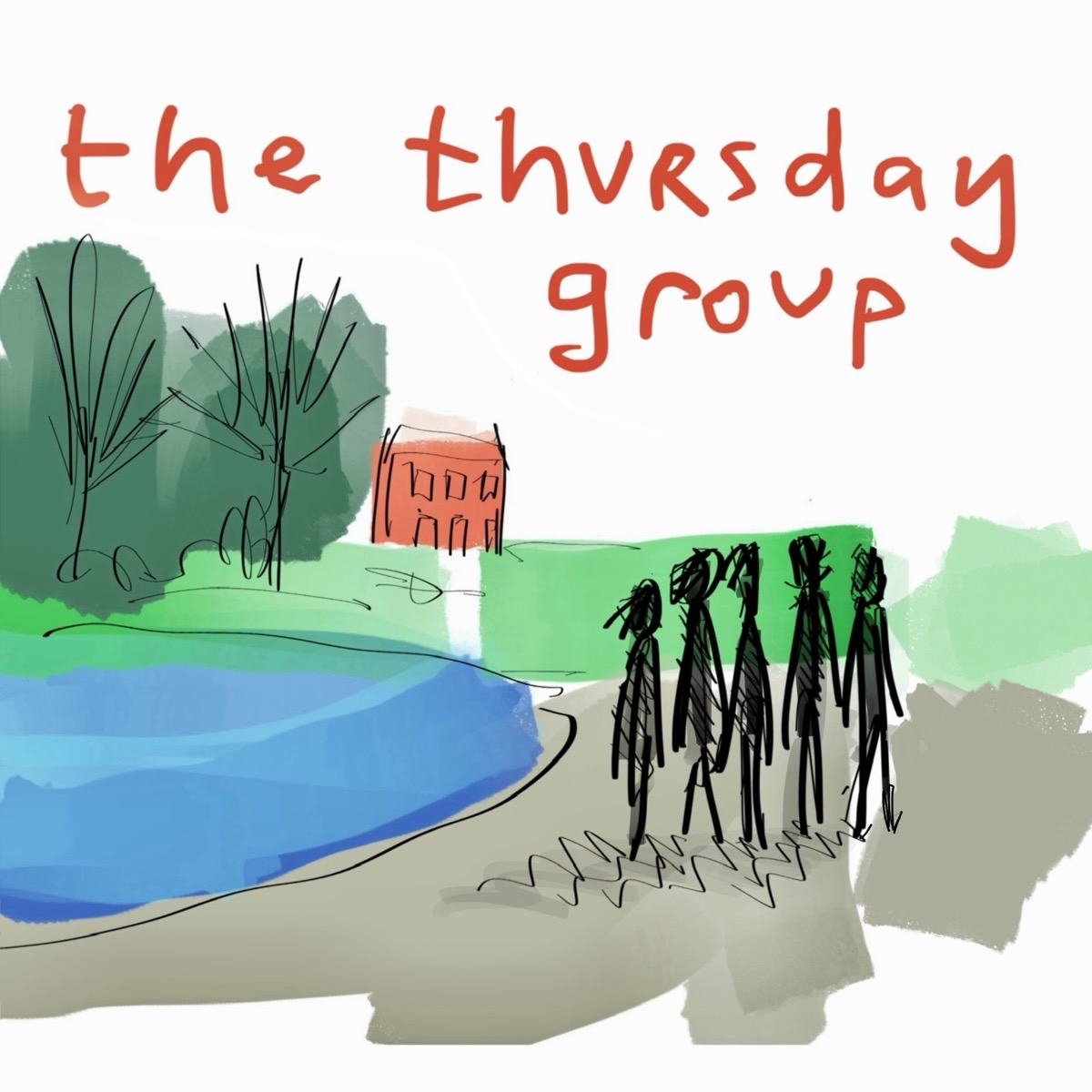
The Thursday Group is my experiment in this: a free one-hour walk on Hampstead Heath, from Whitestone Pond, with five places.
It’s run on open space lines. Everyone says one thing they’re curious about or wrestling with, then the conversation goes wherever the energy is. You can leave any conversation and drift into another whenever you like, and listening counts as taking part.
There’s nothing to buy, and nothing it’s building toward – no funnel, no upsell, no second ask. It belongs to nobody but the people on it.
If you’re a friend, or you’ve been reading me for years, come. And if we’ve never met, you are just as welcome. Whoever comes are the right people.
It’s a small, low-stakes way of picking that thread back up: not an event with a budget and a stage, only an hour, a pond, and whoever turns up.
Where this goes
I don’t know. It may or may not become a regular thing.
It’s meant to keep bringing in new people, not to become a fixed group. The value is partly in never quite knowing who’ll be there, or what they’ll be carrying.
Next walks: the current dates