Beyond borrowed credibility
Why you need a platform of your own
Recently, I opened one of my books and my eyes got stuck on the first sentence, on the first page:
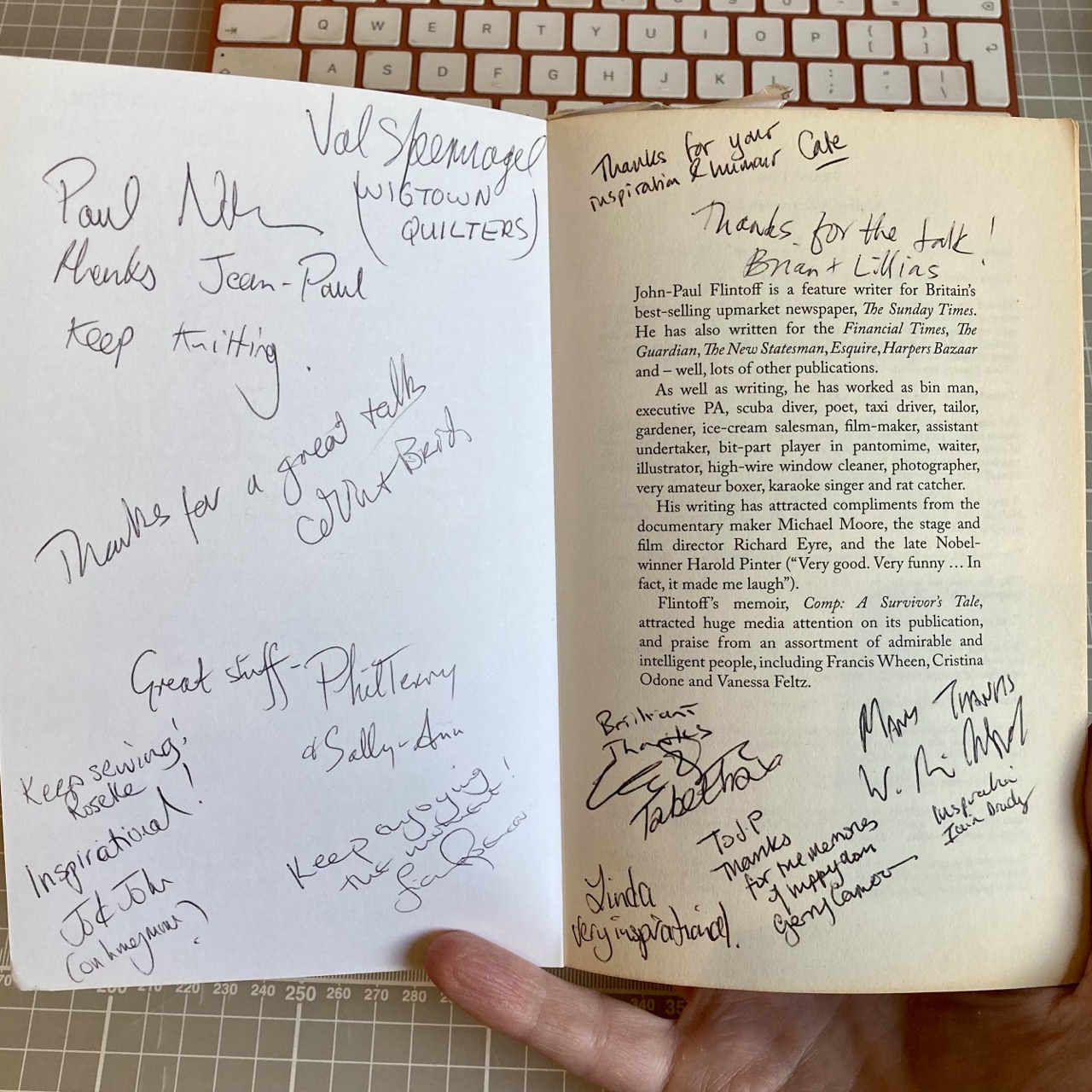
John-Paul Flintoff is a feature writer for Britain’s best-selling upmarket newspaper, The Sunday Times.
Stop and think about it for a moment. What’s going on? Was I boasting? Maybe, but not exactly. I was explaining who I was, and the institution did some of the work for me. Its history, its reach, its heft: in a few words, all that transferred across to me. I was borrowing the paper’s credibility.
In return, without quite noticing, I lent it mine. I was saying, in effect: this organisation is worth attaching my name to.
It took me a while to see that this transaction went in two directions.1
***
Works both ways
It should be obvious, but for some reason it isn’t: every claimed connection works both ways. We borrow from the thing we’re linked to, and we lend to it in return. Most of us only notice the first part.
The corporate employee wears the hoodie, puts the logo on LinkedIn, says “I work for Google” at a party. S/he borrows the tech giant’s prestige and becomes, in return, a walking billboard. The university alumnus carries the institution’s cachet for life, and the institution uses their success to lure the next generation. The person who stands next to the funniest person at the party borrows their social gravity, and validates their status by being part of their entourage.
We all do this. We do it constantly. We have to2. Connection is how we locate ourselves in the world, how we signal who we are when there isn’t time to explain from first principles. Nobody starts from scratch. But the transaction is real, and I just want to be clear that it runs both ways.
***
Building connections
When somebody is starting out, with no platform – no institutional heft, no name to drop – they have nothing to borrow from except their own hunger. So they do what ambitious people have always done: seek connections.
For instance: they interview interesting people for their podcast. Ask smart questions, listen well, put it out into the world. And gradually something shifts. They become not just someone who knows things, but someone who knows people. The guest’s reputation rubs off on them. The connections become the platform.3
This is the purest form of the transaction. Nothing to borrow except what others will lend you. And nothing to lend them except your attention, your curiosity, your growing audience. It’s how reputation gets built from nothing.
Austin Kleon’s Show Your Work! is essentially a handbook for this approach. Be generous, be connected, let the network lift you. It works. It’s how almost everybody starts.
But it’s also a trap, and the trap takes a while to spring.
Breaking connections
Connection isn’t just about people. It’s also about platforms.
If you publish a newsletter with Substack, every email you send lands in a subscriber’s inbox bearing the Substack logo. That’s the first thing your reader sees. You’re advertising Substack, for free, every time you publish.
They give you reach, distribution, a smooth technical experience. You give them your labour, your audience, your growing reputation as someone worth reading. It’s a fair trade, until it isn’t. Because at some point you may start to wonder if you’re building your house on rented land.
Or look at Instagram. Open the app and you think you’re visiting your friends. But the language betrays it: people say “I’m going to check Instagram,” not “I’m going to look at my friends’ photos.” The platform has inserted itself so thoroughly that it has become the destination. Your friends are the reason you go, but the algorithm decides which of them you see. The interface dictates how you interact with them. The company captures the data and sells the ads. You bring the relationships; they take the value.
Recently, I thought about all the artists I follow on Instagram and wondered if there was any way I might find them without Instagram. In many cases, I don’t think there is. Some don’t list any kind of outside presence – no website. My relationship to them, such as it is, remains entirely under the control of Instagram.
On Instagram, I made a screencapture video of all the people I follow who have “art” in their name. Here’s a much speeded-up version of that video:

Maybe one day I’ll go looking for them all. If I found their websites perhaps I could (with permission) list them on my own site.
Platform on fire
Or take Twitter, now called X. Years ago, I was a fan. I used it a lot. But it changed a lot. I found myself starting to hate it. The effect it seemed to have on people I knew! I found it very upsetting. At one particular point, in 2024, I drew this:
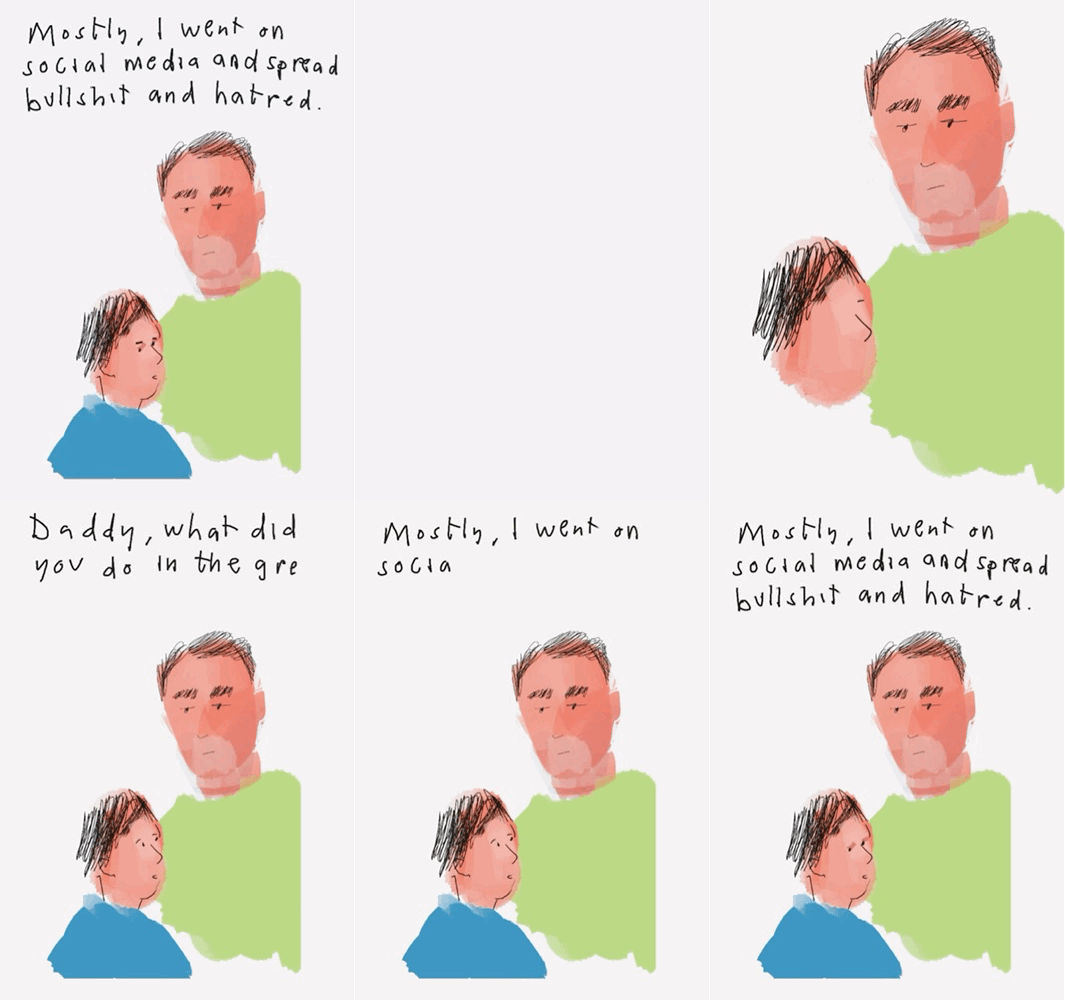
To be honest, I could have drawn something similar long before that.
Tarleton Gillespie’s Custodians of the Internet explains how platforms shape what we see while pretending to be neutral. Shoshana Zuboff’s The Age of Surveillance Capitalism spells out what’s really happening when we trade our attention and our connections for “free” services. We are not the customer. We are not even the product. We are the raw material.
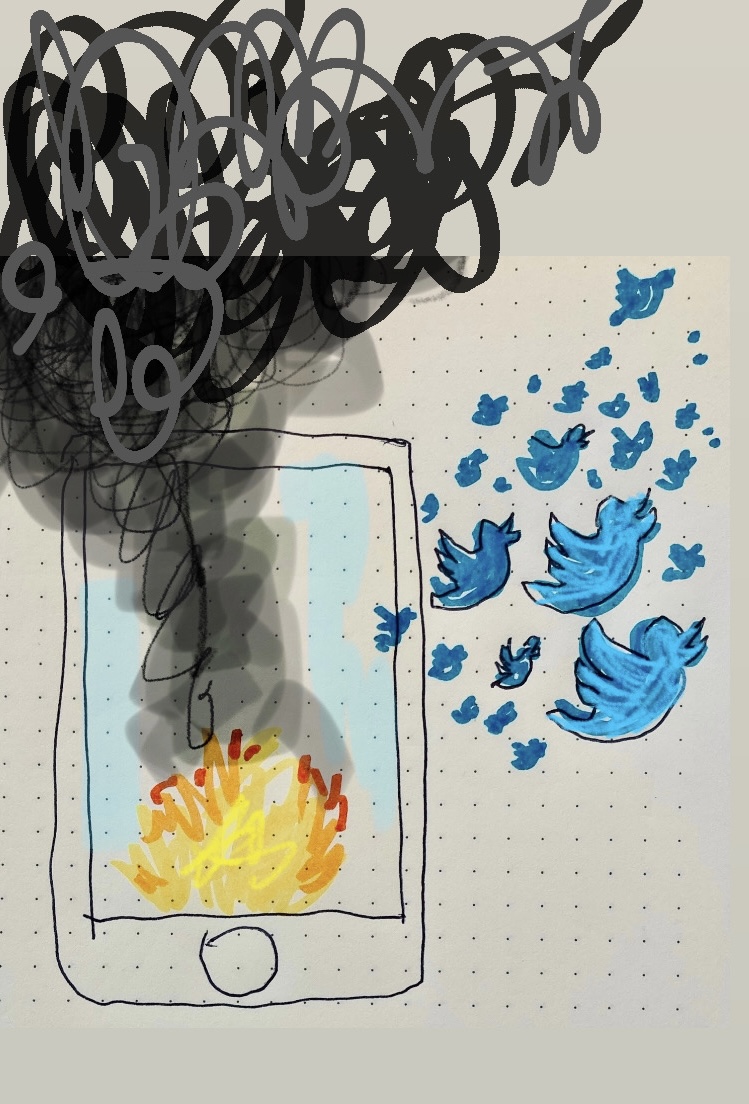
I wasn’t the only person to turn away from Twitter / X. Many others too decisively broke the connection. Here’s another drawing I made at the time:
Hostage to fortune
Connections are assets, but also liabilities. When you lend your reputation to someone, you can’t call it back.
I’m thinking for example of the people who wrote enthusiastic quotes of praise to appear on the book of someone who subsequently went through some kind of public disgrace. How awkward to have your words of praise remain on all those book covers forever after! Or it could work the other way around, where somebody gives a quote for YOUR book, and then that person falls into dishonour. Either way, this remains attached to you, visible, searchable, awkward. You transferred a little of your good name to them, and the transfer is irreversible.
Erving Goffman’s The Presentation of Self in Everyday Life, written in 1959, remains the best account of this. He saw that we’re all performing, all managing the signals we send, and that the performances depend on things we can’t fully control. The stage we stand on can collapse (hello, Twitter!). The other actors can let you down.
Tom Nichols, in The Death of Expertise, traces what happens when institutional connections break down entirely. Chris Rojek, in Presumed Intimacy, examines how we mistake platform-mediated relationships for real ones – and how brittle those relationships turn out to be.
The partial withdrawal
Perhaps this is why I’ve been pulling back lately.
For some months now, I’ve been weaning myself off Instagram. Not because I don’t want to see my friends’ photos – I do – but because I’ve started to feel the shape of the transaction. I bring the relationships. Meta takes the data, the attention, the ad revenue. I lend Mark Zuckerberg my network, and he lends me… what, exactly? A filtered view of the people I care about, arranged by an algorithm that serves his interests, not mine.
I’ve had this website for nearly 25 years, and I’m giving it more of my attention again. I write things here that are sent out as emails delivered via RSS. There’s no platform between me and the people who read me. I can change the email newsletter service I use at any time (with, admittedly, some minor inconvenience). No logo but my own initials. No algorithm deciding who sees what. It’s smaller, slower, less efficient. But it’s mine.
I wish that everybody had something like this.
Jenny Odell, author of How to Do Nothing, is not a Luddite. She doesn’t advise us to abandon technology. She’s saying resist the capture of your attention by platforms that don’t deserve it. Cal Newport’s Digital Minimalism makes a similar case: opt in deliberately, rather than defaulting to whatever connection is easiest.
Only connect
The double effect of connection – borrowing and lending, lifting and endorsing – is not a glitch. It’s how human society works. We build ourselves through our affiliations. We signal who we are by naming who we’re with. The podcaster interviewing guests, the blurb-writer praising a friend, the employee wearing the company hoodie, the journalist dropping the name of their paper: none of this is wrong. It’s inevitable. It’s how we locate ourselves in the world.
But there’s a difference between having connections and being defined by them. There’s a difference between borrowing from institutions and being owned by them.
Lewis Hyde, in The Gift, has a chapter on how reputation circulates like gift exchange. You give praise, you receive standing. You lend your name, you borrow someone else’s. It’s a kind of economy, and like any economy, it functions best when participants are free and independent. When you have something of your own to bring to the exchange.
The podcaster who only ever interviews others, who never develops their own voice – their own perspective, their own body of work – is not building a platform but a waiting room. They’re permanently borrowing, never lending anything of their own.
And the writer or artist who builds on Substack, Twitter Instagram but never creates an independent space, never owns their audience directly, never has a place that isn’t subject to someone else’s terms of service? They’re a tenant, not an owner. They can be evicted.
A site of one’s own
We all need something of our own. Not instead of connections: that’s impossible and undesirable. But alongside them. A space that isn’t borrowed. A place where you can show up as yourself, not a node in someone else’s network, not a walking endorsement for someone else’s platform.
For me, that’s an independent website. For you, it might be something else. A notebook. A garden. A practice. A voice that doesn’t depend on who’s listening. Did I miss something else?
The double effect of connection is real, and it’s permanent. Like me, you will borrow and you will lend, whether you notice it or not. The only question is whether you are conscious of it.
1 Two directions. My wake-up came in 2011 when a huge phone-tapping scandal blew up, leading to the closure of The News of The World, which like the Sunday Times was owned by Rupert Murdoch. Even though The Sunday Times itself wasn’t guilty, the association with the News of the World, and Murdoch’s empire generally, created reputational spillover that made me (and many, many others) uncomfortable.
2 We all do this. We have to. I do it myself here, on this site, in a page promoting my work. Look carefully at the last part (after the hashtag) in the name I have given to this link: flintoff.org/my-public-events#borrowedcredentials
3 Connections become the platform. At a certain point, they may enjoy greater esteem than the people they once sought out. Would-be guests may start clamouring to appear on the podcast, and they find themselves having to turn away guests they would once have died for.