Artist's proofs and editions
How my prints work: why there is often no original, what a proof is, and what may happen afterwards
I make very few of any picture – whether it’s a person, a room, or a house from the street.
First, a word about originals
A lot of my work is drawn on an iPad. So in many cases there is no original – no single object I made with my hands that everything else is a copy of.
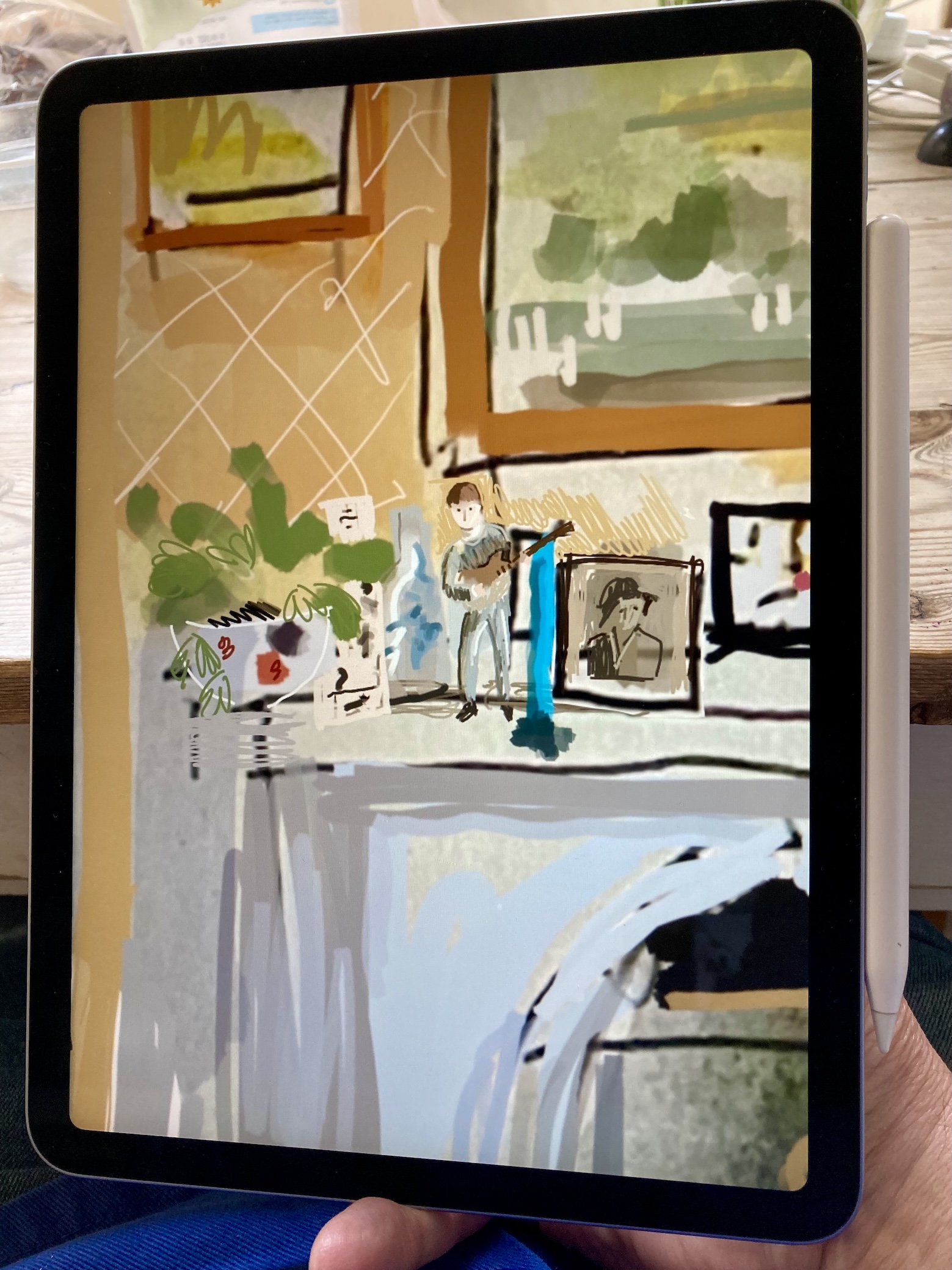
That’s a picture being made – the mantelpiece in Hunter Davies’s study, drawn on the iPad with an Apple Pencil. When it’s finished there’ll be no object to hang. There’ll be a file, and then prints made from it. The first print off the press is no more original than the second. They’re identical until the moment I put a pencil to the margin and write on one of them.
That’s what the signature does. It doesn’t certify that a print is the original. It makes it a particular one: this is a proof, or this is number nine of ten. The writing is the thing that separates one sheet from another.
I think people sometimes assume that because there’s no canvas somewhere, the prints are all just copies. It’s closer to the truth to say the print is the work, and the inscription tells you which print it is.
Two ways to own a picture
There are two ways to own one of my pictures.
A unique print is the only one of its kind – the image at A2, with a white border on top of that, so the paper is larger than A2. Signed, dedicated, and yours alone. Nobody else can ever have that image. Three thousand pounds.
A print from a limited edition is one of ten, on A2 paper, signed and numbered. Four hundred pounds. Other people can own a print from the same edition, so it isn’t unique – but it’s a real, signed work, and it fits a standard A2 frame. Editions are also made smaller, down to A5: the sizes and prices are on my can I buy a print page.
The prices, and what each one means, are set out on my how to buy a portrait page.
Proofs
Whichever way a picture is owned, I keep one artist’s proof for my own records. A proof carries my working marks, and it’s mine – it isn’t the print you buy.
If you commissioned the work, your print is signed and dedicated to you, and not marked as a proof.
If I came to you – because I wanted to draw you, or your house, or the room you work in, and you said yes – then there’s no obligation to buy anything. If you would like to own the picture, you can, either as the unique print or from an edition, exactly as above.
Editions
Artist’s proofs sit outside any edition. They’re made first, they carry my working marks, and they aren’t counted in the numbering. So a proof stays a proof whatever follows.
That does mean a proof isn’t always the only print of a picture that exists, and I’d rather say so than let anyone assume otherwise. A few people do own proofs, bought before I offered the unique print. If you own a unique print, that image is yours alone and I won’t make an edition of it. If you own a proof and I’m considering an edition of that picture, I’ll tell you before I do.
How they’re made
Prints are made on Hahnemuhle German Etching paper by a specialist in Hoxton, east London.