When I teach writing, I often talk about the benefits of a constraint. A deadline, say.
Or I talk about Georges Perec, who wrote a whole novel without the letter “e”. He was one of a group of writers who gather under the name Oulipo. They created complex, challenging formats precisely because they believed (I paraphrase) that the more you constrain creativity, the more you liberate it. I’ve written about them before, in A Recipe For Writing.
In How To Write, the course I recorded for The Idler, one lesson asks people to write exactly 49 words about why they are doing the course, why they want to write, or write more, or differently. Too many words, cut back to 49. Not enough, add more.
This is a page from my notebook, from when I was preparing that course.
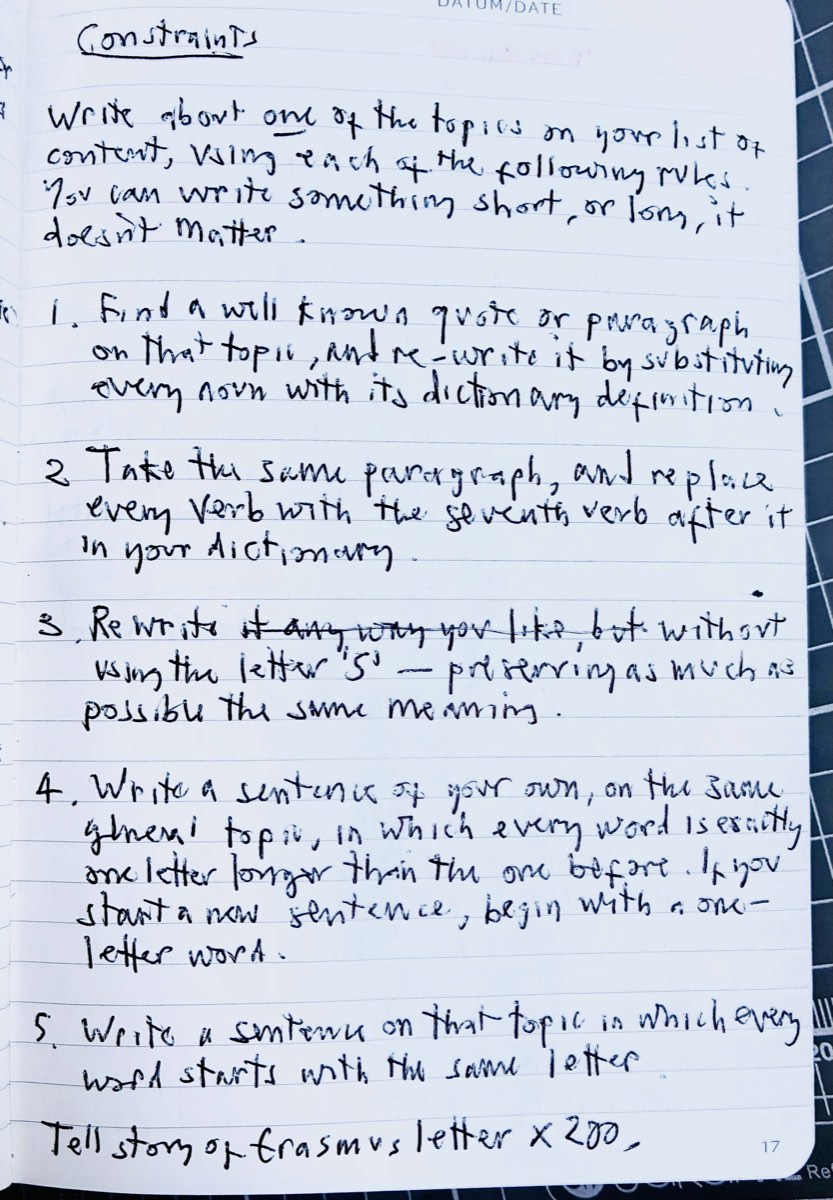
In case you can’t read my handwriting, it says:
Write about one of the topics on your list of content, using each of the following rules. You can write something short, or long, it doesn’t matter.
- Find a well known quote or paragraph on that topic, and re-write it by substituting every noun with its dictionary definition.
- Take the same paragraph, and replace every verb with the seventh verb after it in your dictionary.
- Rewrite without using the letter “s” – preserving as much as possible the same meaning.
- Write a sentence of your own, on the same general topic, in which every word is exactly one letter longer than the one before. If you start a new sentence, begin with a one-letter word.
- Write a sentence on that topic in which every word starts with the same letter.
Number 3 began as “Rewrite it any way you like”. I crossed that out.
The last line on the page says: “Tell story of Erasmus letter x 200.” Erasmus once demonstrated a couple of hundred ways to write a single sentence: “I was very pleased to receive your letter.”
Somebody who took the course wrote to tell me what one of the exercises had done for them, and I shared the email. It confirmed what I have long believed about the creative power of constraints: the more you’re squeezed, the more comes out.
Pick one of the five, and try it.
And if you haven’t done it already, here’s the course: How To Write With John-Paul Flintoff.
-If you enjoyed this post, please consider sharing it by email or on social media. Here's the link. Thanks, JPF.