Day 3: A catalogue of coffins
Transcript
Hi, this is John-Paul, and this is another voice note for members of the Micro-Memoir course, and it’s based on a Zoom conversation I had in my calendar for quite some time with someone who then became a member of the course, one of the course participants, and Paula said, it’s okay for me to share this because it might be useful to other people.
So Paula had in mind one particular idea for her micro-memoir, the book that she’s writing in this 30-day period in November, and it’s turned out that that’s not possible, and so she’s a bit blank, and she’s thinking what could she do instead, and we came up with an idea, but I want to tell you how we got there, because I think some of what we covered in our conversation might be useful to other people.
So the original idea was more or less straightforwardly to share some beautiful creative work by one of her relations, and put it in a book and get it printed, and it could be shared with other people. And that relied on the power of the creative work itself.
For various reasons, that isn’t possible, but in passing, Paula just happened to mention that she had shown some of that work to one of her neighbours, who, as it happens, used to work in publishing, and the neighbour had cried at how wonderful it was.
So I stopped for a second and said that it can be very useful to show the relationship between a thing and the people around it, or between people. So you could just show the creative work, or you could show Paula showing the creative work to the neighbour who cries about it.
So I was saying, what you can do is step back a bit, don’t just focus at the work, step back and show the people around it, the one who wants to share it, the one who reads it and cries. Because the relationships and the emotional effect can be part of your story, and it’s quite easy to forget that they’re important.
But anyway, we had to put that aside, because that’s not what she’s going to do.
So what was she going to do? Well, the second, newer idea was for Paula to write about a time in her career when she set up an unusual business, a very unusual business, a quirky funeral business, that involved, among other things, having very unusual coffins in the shape of a car, or in the shape of an air force jet.
And each of the coffins can be shown in the micro-memoir with a photograph, but it also could have a story attached to it. And we agreed that that would be a great thing. So, in a way, the micro-memoir functions as a catalogue of coffins, and maybe some other things in the funeral director’s.
But I just want to come back to this point about standing back and zooming out a bit. So instead of just being a catalogue of coffins, what if we zoomed out and allowed Paula, in the present day, to appear at the beginning and the end of the book?
What if she starts the book by saying, well, I wanted to do a book about my relation’s beautiful creative work, but I can’t do it, and so what am I going to do instead? And then goes into the coffin business, and then ends in the present day with some kind of reflection on what it was like at that time, some years ago, to run the coffin business, funeral business.
And as it happens, the reason for this framework is visually led. Paula showed me a photograph of a rather comic-looking kind of cartoony skeleton figure that she keeps hanging around in her house. And I thought it could be quite funny to show that in the present day, Paula still has that thing, and it’s quite an obvious way into the whole story about the funeral business.
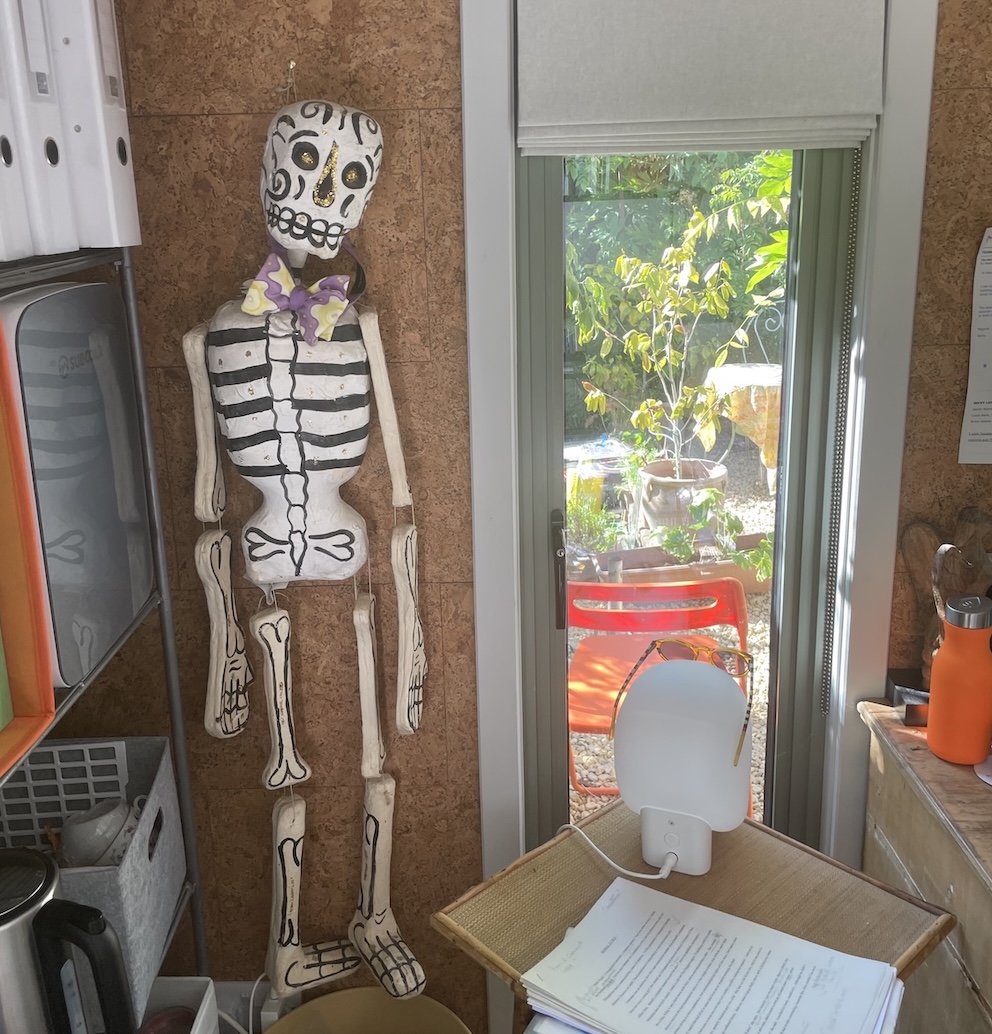
So the framework is justified. It shows two different time periods, the present and the past, and it comes back to the present for some reflection.
I have no idea whether this is helpful to other people. I think it could well be.
And all I can say now is I’ll try to see if I can get hold of a photograph of that skeleton figure, which Paula calls Mr Bones, and I’ll put it into this episode.
Thank you so much for listening.