Speak Like A Human: Talks and workshops
I’ve spoken on four continents to audiences of as many as 5,000 people – but saying it like that sounds like I’m really pleased with myself, like I think I’m special.
Which isn’t the plan at all.
What I hope to get across more than anything else is that I’m not special. Or if I am special – well, so are you, and so is everybody else.
We all have a voice, and something to say. We all deserve to be heard.

Hi, I’m John-Paul Flintoff. This part of my website is about the art of Speaking Well Enough. It builds on A Modest Book About How To Make An Adequate Speech.
This page is about talks and workshops I have delivered, in person and online, for companies and organisations.
Click on these links to jump ahead:
Impact and Presence | Talks About Talks | How To Change The World | Where Do Great Ideas Come From? | How To Have A Breakdown | Clients | Contact
Impact and Presence
When the room is full of people who may not know each other, and perhaps a strong sense of hierarchy, I begin with Rock-Paper-Scissors, played as a knockout.
I ask everyone to play their very best game, which gets a laugh, because there’s no skill in it at all. Lose, and you become the greatest supporter of the person who beat you. Ten or fifteen minutes later the whole room is behind one of two finalists, and when I hold up the winner’s arm it could be a senior partner or someone from the post room – anyone.
It gets a lot of people facing each other, competing with each other, and then cheering for each other. The rest of the session builds on that.
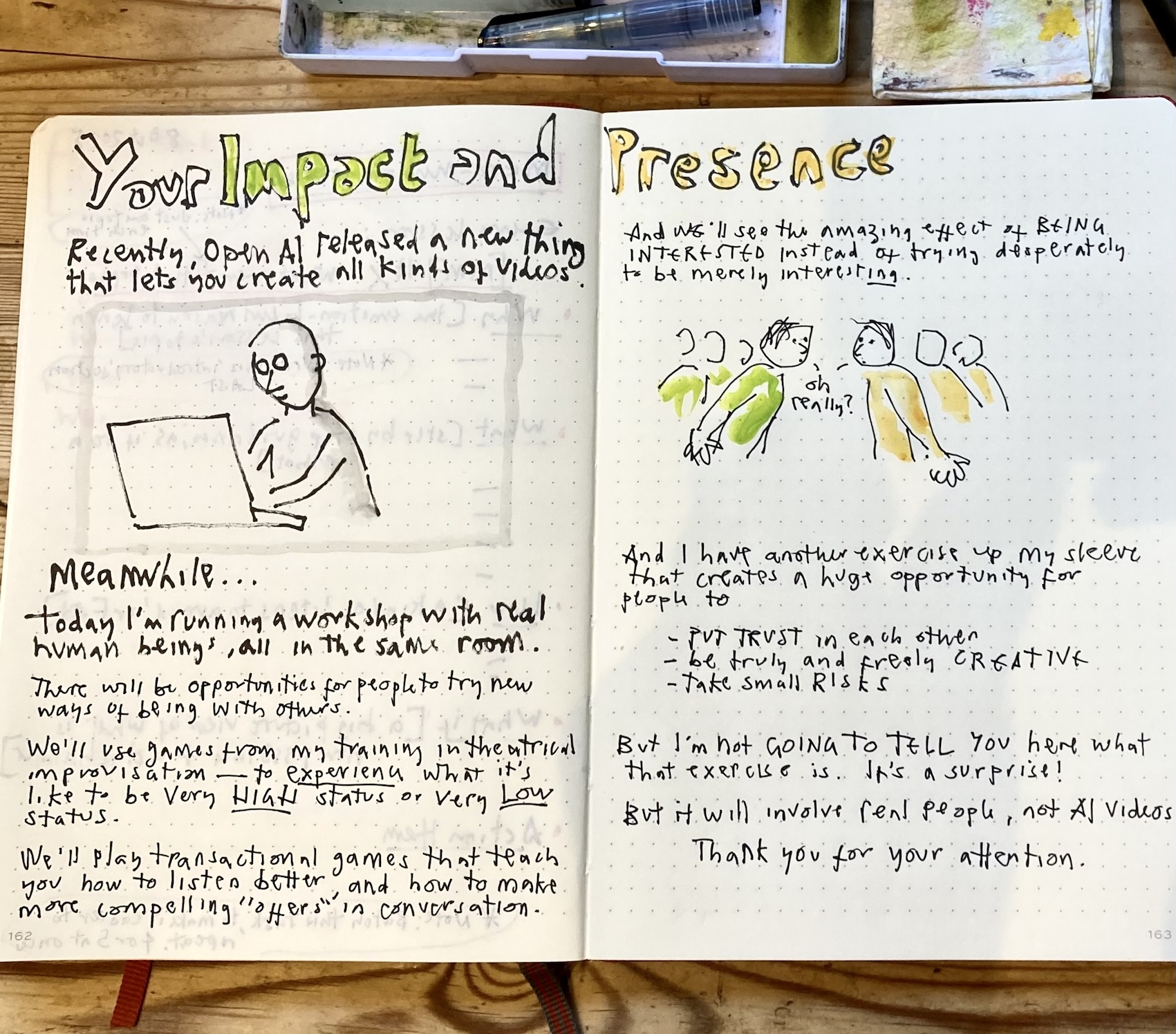
From my notebook, before one of these workshops.
The exercises come from my training in theatrical improvisation with Keith Johnstone. They show how we signal status without meaning to, how we block each other’s ideas without meaning to, and how the way we listen to someone can make them more interesting, more confident, more worth knowing.
It isn’t a lecture, and there’s no move anyone can make that is wrong – if something feels off, that’s on me. People leave having laughed, taken small risks together, and connected with colleagues they may have known only by name.
I’ve run it for partner and senior associate groups at Magic Circle firms. It takes 60 or 90 minutes, in person, for a room of up to 100.
Sit up and take notice
“There is nothing more scary, in a firm where people charge for their time, than risking wasting their time. If they hadn’t found your talk interesting and relevant, some would have voted with their feet and left. You connected with the audience immediately. I could see people sit up and take notice.”
– Jo Gubbay, Slaughter and May
Talks About Talks
This is an out-take from an online talk. Please watch. It’s important, because the greatest difference between giving a talk and, say, writing is the living presence of human beings, right there and then.

I like to establish a sense of connection from the start. Let people know I see them.
(You too: hello you!)
Here’s a bit from later in that Q&A, about why I wrote a book on public speaking, and how you can do most things wrong and still be fine.

Testimonial
Avalanche of Positivity
“Thank you so much for delivering that talk. I know it is strange talking into the void [online] but it went so well and the level of positive comments received was huge. It all came through on chat and Q&A as we were logging off – I have never seen such an avalanche of positivity.”
– Mishcon de Reya
To watch the talk in question, click on the picture.

How To Change The World
This talk took place at TEDx Athens. It’s about changing the world – if not necessarily the whole world, at least your world.
It’s 17 minutes and 25 seconds long: short considering that it gives you the essentials of my 2012 book.

A bit too short, perhaps: I packed a lot in, which is why I talk a bit too fast.
But hey, it was one of the first times I’d made a speech like this, to a big audience, outside the UK, and I confess I was nervous and eager to deliver lots of useful tips.
If you’d like to download the transcript, it’s here:
How To Change The World TEDx Athens John-Paul Flintoff Transcript.pdf (132.9 kB)
Where Do Great Ideas Come From?
Short Answer: they just pop into our heads, and we only need to get out of the way. Longer Answer:
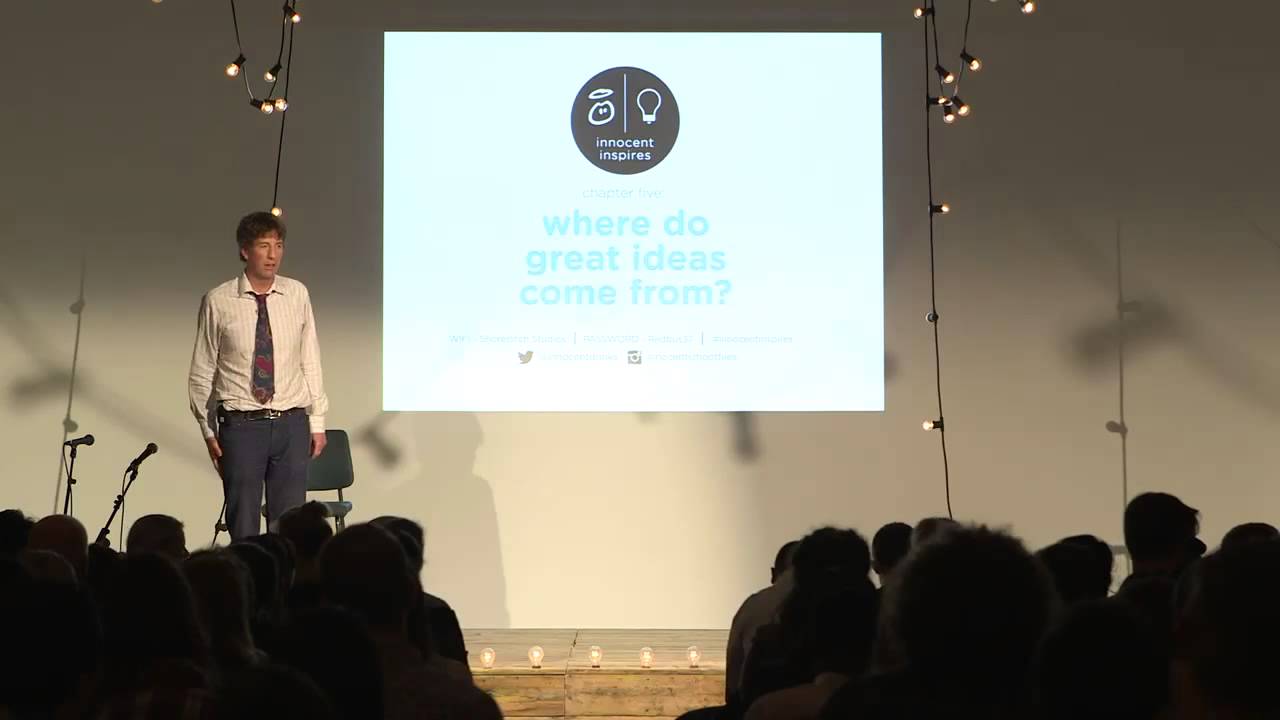
13 mins 08 seconds
One of the other speakers at that event was the poet Benjamin Zephaniah. What I remember about his talk was the wonderful observation that we only have 26 letters in the alphabet, but every day we have the chance to say something we never said before.
Another performer, I recall, played the flute with his nostrils. And you don’t get to say that very often.
How To Have A Breakdown
I had a breakdown in 2018, went into psychiatric hospital for eight weeks and am much the better for it, thank you for asking.
I’ve delivered lots of talks about my experience – what led up to it, what happened in hospital, and how I gradually recovered – using drawings that I made in hospital.

What with Covid, many of these talks have taken place online.
Talking online and screen-sharing turned out to be a great blessing, because people in the audience could comment to me privately in the chat, and ask questions for me to answer without giving away anybody’s identity.
Those comments and questions were often very raw. And when I shared them (anonymously) with the rest of the organisation, the effect was very powerful. If you’re curious, you can read more about this, and download a screenful of those comments, on this page
***
Some companies and organisations I’ve worked with:
Royal College of Art, University of the Arts London, The Idler Academy, The School of Life, London Business School, University of Edinburgh, Accenture, EY, D&AD, Ogilvy, Stella McCartney, American Express, Experian, HSBC, Triodos, Innocent, Moet Hennessy, Unilever, The Office of the First Minister and the Deputy First Minister of Northern Ireland, Bupa, Great Ormond Street Hospital, Healthwatch, Monitor, Rocco Forte Hotels, Octavia, Aviva, FieldFisher, FTI, Slaughter and May, Linklaters, Freshfields, Mishcon de Reya, Macfarlanes, Birketts, Clyde & Co, Norton Rose Fulbright, Weil, SpaceNK, BBC, Channel 4, United Nations, Department Store for the Mind, Selfridges, White Stuff, Saracens, Google, Microsoft, O2, The Phone Co-op, Vodafone.
***
Contact
If you represent an organisation and would like me to speak, please jp at this domain name, Jaime Marshall.
If you’re an individual, looking to improve your speaking, see this page.